explain why rolles theorem cannot be applied to the function f(x)=|x| on the interval -a,a for any a>0…
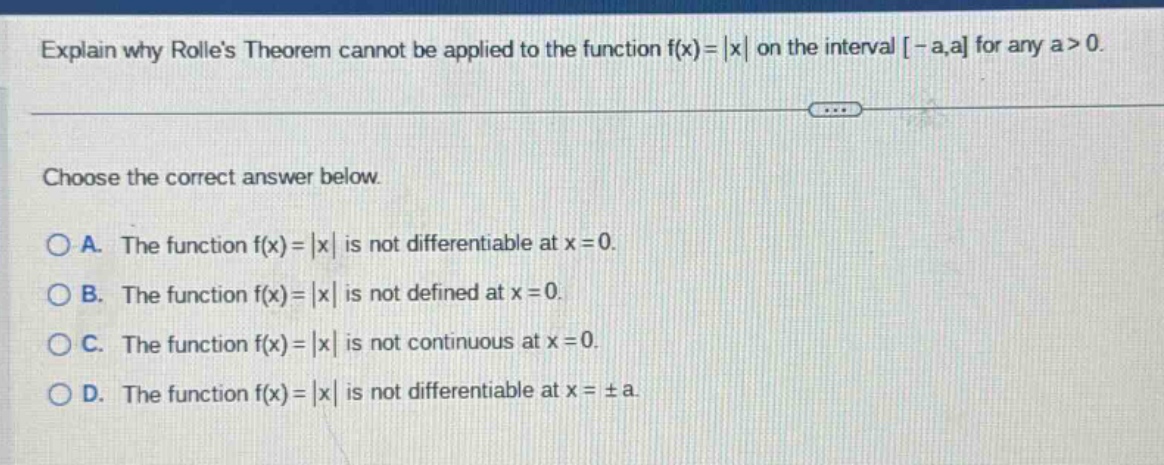
explain why rolles theorem cannot be applied to the function f(x)=|x| on the interval -a,a for any a>0. choose the correct answer below. a. the function f(x)=|x| is not differentiable at x = 0. b. the function f(x)=|x| is not defined at x = 0. c. the function f(x)=|x| is not continuous at x = 0. d. the function f(x)=|x| is not differentiable at x = ±a.
Answer
Brief Explanations:
Rolle's Theorem requires a function to be continuous on the closed - interval, differentiable on the open - interval, and have equal function values at the endpoints of the interval. The function $f(x)=|x|$ is continuous on $[-a,a]$ and $f(-a)=f(a)=a$. However, the graph of $y = |x|$ has a sharp corner at $x = 0$. The derivative from the left of $x = 0$ is $- 1$ and the derivative from the right of $x = 0$ is $1$. So, $f(x)=|x|$ is not differentiable at $x = 0$ which is in the open interval $(-a,a)$.
Answer:
A. The function $f(x)=|x|$ is not differentiable at $x = 0$.