which exponential function has an initial value of 2?\n$f(x)=2(3^{x})$\n$f(x)=3(2^{x})$\n
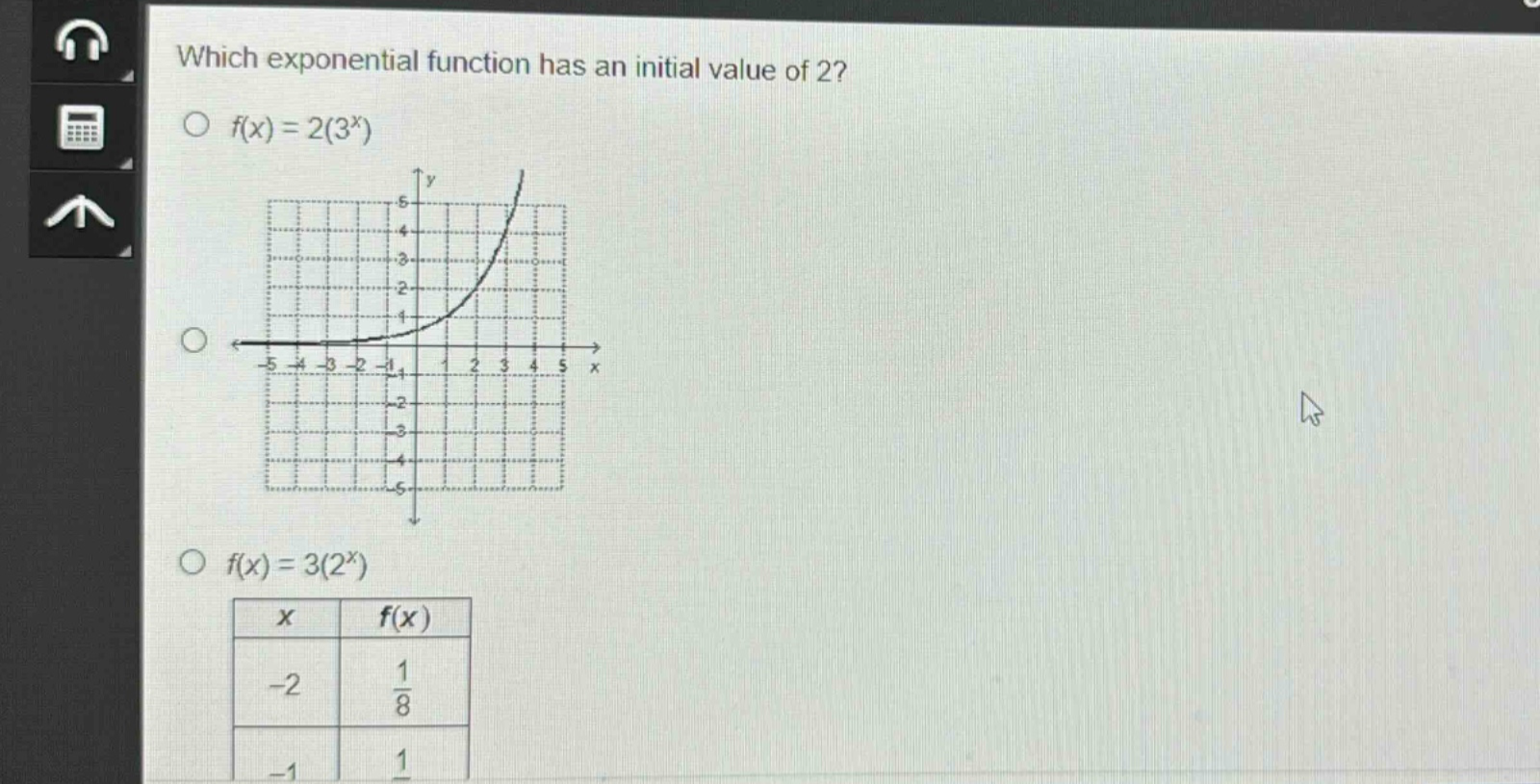
which exponential function has an initial value of 2?\n$f(x)=2(3^{x})$\n$f(x)=3(2^{x})$\n
Answer
Answer:
A. ( f(x) = 2(3^{x}) )
Explanation:
Step1: Recall the general form of an exponential function
The general form of an exponential function is ( f(x)=a\cdot b^{x}), where (a) is the initial - value (the value of the function when (x = 0)).
Step2: Find the initial - value for (f(x)=2(3^{x}))
Substitute (x = 0) into (f(x)=2(3^{x})). Using the property (b^{0}=1) for (b\neq0), we have (f(0)=2\times3^{0}). Since (3^{0}=1), then (f(0)=2\times1 = 2).
Step3: Find the initial - value for (f(x)=3(2^{x}))
Substitute (x = 0) into (f(x)=3(2^{x})). Using the property (b^{0}=1) for (b\neq0), we have (f(0)=3\times2^{0}). Since (2^{0}=1), then (f(0)=3\times1=3).
Step4: Analyze the graph (if needed)
For an exponential function (y = a\cdot b^{x}), when (x = 0), (y=a). If we consider the (y) - intercept (the point ((0,y)) where the graph crosses the (y) - axis), for (y = 2(3^{x})), the (y) - intercept is ((0,2)). For (y = 3(2^{x})), the (y) - intercept is ((0,3)).