an exponential function has an initial value of 500 and a decay rate of 15%. compare the average rate of…
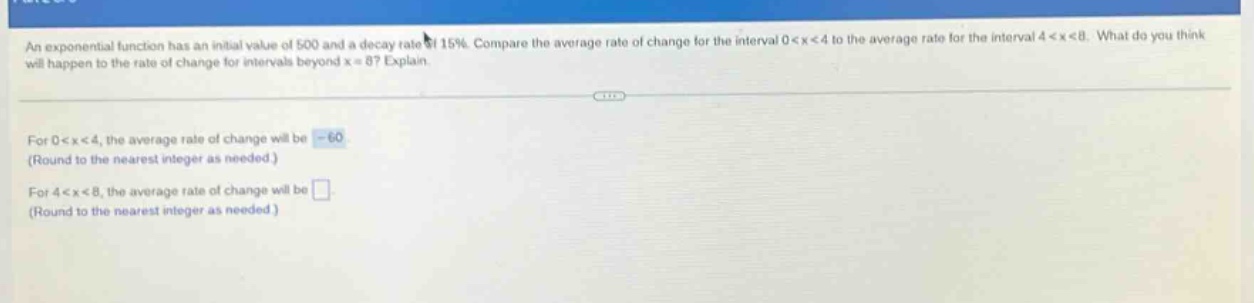
an exponential function has an initial value of 500 and a decay rate of 15%. compare the average rate of change for the interval 0 < x < 4 to the average rate for the interval 4 < x < 8. what do you think will happen to the rate of change for intervals beyond x = 8? explain. for 0 < x < 4, the average rate of change will be -60 (round to the nearest integer as needed.) for 4 < x < 8, the average rate of change will be (round to the nearest integer as needed.)
Answer
Explanation:
Step1: Write the exponential - decay function
The general form of an exponential - decay function is $y = a(1 - r)^x$, where $a$ is the initial value and $r$ is the decay rate. Given $a = 500$ and $r=0.15$, the function is $y = 500(0.85)^x$.
Step2: Calculate the average rate of change formula
The average rate of change of a function $y = f(x)$ over the interval $[m,n]$ is $\frac{f(n)-f(m)}{n - m}$.
Step3: Calculate the average rate of change for the interval $4\lt x\lt8$
First, find $y(4)$ and $y(8)$. $y(4)=500(0.85)^4=500\times0.52200625 = 261.003125$. $y(8)=500(0.85)^8=500\times0.2724905277 = 136.2452638$. The average rate of change over the interval $4\lt x\lt8$ is $\frac{y(8)-y(4)}{8 - 4}=\frac{136.2452638 - 261.003125}{4}=\frac{- 124.7578612}{4}\approx - 31$.
Answer:
$-31$