an exponential function has an initial value of 500 and a decay rate of 16%. compare the average rate of…
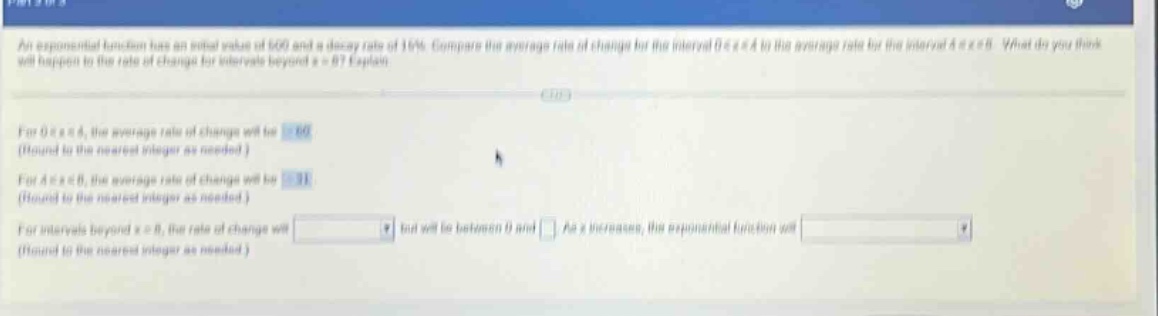
an exponential function has an initial value of 500 and a decay rate of 16%. compare the average rate of change for the interval 0 < x < 4 to the average rate for the interval 4 < x < 8. what do you think will happen to the rate of change for intervals beyond x = 8? explain. for 0 < x < 4, the average rate of change will be 120 (round to the nearest integer as needed.) for 4 < x < 8, the average rate of change will be 31 (round to the nearest integer as needed.) for intervals beyond x = 8, the rate of change will but will be between 0 and as x increases, the exponential function will (round to the nearest integer as needed.)
Answer
Explanation:
Step1: Define the exponential - decay function
The general form of an exponential - decay function is $y = a(1 - r)^x$, where $a$ is the initial value and $r$ is the decay rate. Given $a = 500$ and $r=0.16$, the function is $y = 500(0.84)^x$.
Step2: Calculate the average rate of change for $0\leq x\leq4$
The average rate of change of a function $y = f(x)$ over the interval $[x_1,x_2]$ is $\frac{f(x_2)-f(x_1)}{x_2 - x_1}$. For $x_1 = 0$ and $x_2 = 4$, $f(0)=500(0.84)^0 = 500$ and $f(4)=500(0.84)^4=500\times0.49787136\approx248.93568$. The average rate of change is $\frac{248.93568 - 500}{4-0}=\frac{- 251.06432}{4}\approx - 63$.
Step3: Calculate the average rate of change for $4\leq x\leq8$
For $x_1 = 4$ and $x_2 = 8$, $f(4)\approx248.93568$ and $f(8)=500(0.84)^8=500\times0.24780995\approx123.904975$. The average rate of change is $\frac{123.904975 - 248.93568}{8 - 4}=\frac{-125.030705}{4}\approx - 31$.
Step4: Analyze the rate of change for $x\gt8$
As $x$ increases for an exponential - decay function $y = a(1 - r)^x$ ($0\lt r\lt1$), the function gets closer and closer to $y = 0$. The rate of change will be negative and will get closer to $0$. So for intervals beyond $x = 8$, the rate of change will be negative and will be between $0$ and $- 1$. As $x$ increases, the exponential function gets closer to $0$.
Answer:
For $0\leq x\leq4$, the average rate of change is approximately $-63$. For $4\leq x\leq8$, the average rate of change is approximately $-31$. For intervals beyond $x = 8$, the rate of change will be negative and will be between $0$ and $-1$. As $x$ increases, the exponential function gets closer to $0$.