what are the extrema of the function using the first derivative test?\n\n$f(x)=\frac{1}{2}x^{4}+\frac{2}{3}x^…
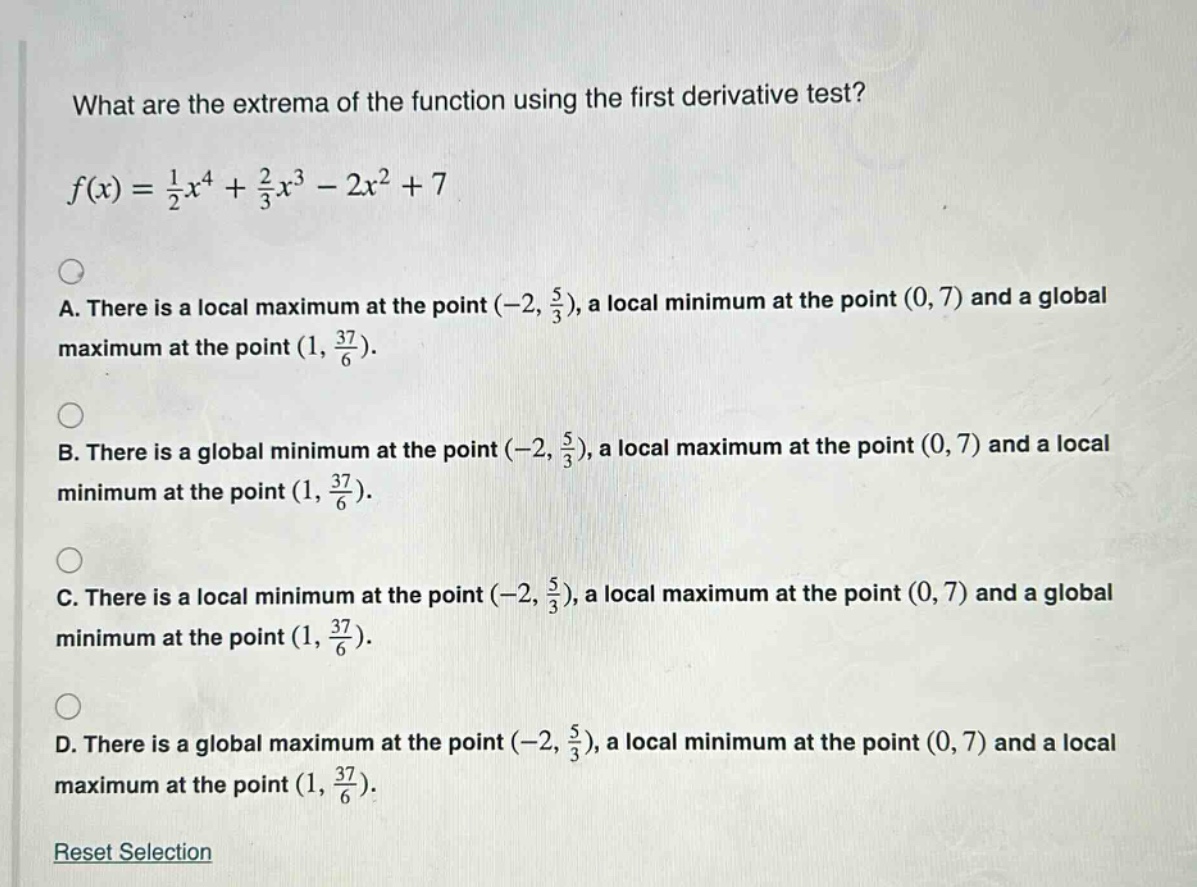
what are the extrema of the function using the first derivative test?\n\n$f(x)=\frac{1}{2}x^{4}+\frac{2}{3}x^{3}-2x^{2}+7$\n\na. there is a local maximum at the point $(-2,\frac{5}{3})$, a local minimum at the point $(0,7)$ and a global maximum at the point $(1,\frac{37}{6})$.\n\nb. there is a global minimum at the point $(-2,\frac{5}{3})$, a local maximum at the point $(0,7)$ and a local minimum at the point $(1,\frac{37}{6})$.\n\nc. there is a local minimum at the point $(-2,\frac{5}{3})$, a local maximum at the point $(0,7)$ and a global minimum at the point $(1,\frac{37}{6})$.\n\nd. there is a global maximum at the point $(-2,\frac{5}{3})$, a local minimum at the point $(0,7)$ and a local maximum at the point $(1,\frac{37}{6})$.\n\nreset selection
Answer
Explanation:
Step1: Find the first - derivative
Differentiate $f(x)=\frac{1}{2}x^{4}+\frac{2}{3}x^{3}-2x^{2}+7$ using the power rule. $f'(x)=2x^{3}+2x^{2}-4x = 2x(x^{2}+x - 2)=2x(x + 2)(x - 1)$.
Step2: Find the critical points
Set $f'(x)=0$. Then $2x(x + 2)(x - 1)=0$. The critical points are $x=-2,x = 0,x = 1$.
Step3: Create intervals and test the sign of $f'(x)$
The intervals are $(-\infty,-2),(-2,0),(0,1),(1,\infty)$. For $x\in(-\infty,-2)$, let $x=-3$. Then $f'(-3)=2\times(-3)\times(-3 + 2)\times(-3 - 1)=-24<0$. For $x\in(-2,0)$, let $x=-1$. Then $f'(-1)=2\times(-1)\times(-1 + 2)\times(-1 - 1)=4>0$. For $x\in(0,1)$, let $x=\frac{1}{2}$. Then $f'(\frac{1}{2})=2\times\frac{1}{2}\times(\frac{1}{2}+2)\times(\frac{1}{2}-1)=-\frac{5}{4}<0$. For $x\in(1,\infty)$, let $x = 2$. Then $f'(2)=2\times2\times(2 + 2)\times(2 - 1)=16>0$.
Step4: Determine the extrema
Since $f'(x)$ changes sign from negative to positive at $x=-2$, $f(-2)=\frac{1}{2}\times(-2)^{4}+\frac{2}{3}\times(-2)^{3}-2\times(-2)^{2}+7=\frac{1}{2}\times16+\frac{2}{3}\times(-8)-2\times4 + 7=\frac{16}{2}-\frac{16}{3}-8 + 7=\frac{48-32 - 48+42}{6}=\frac{5}{3}$, so there is a local minimum at $(-2,\frac{5}{3})$. Since $f'(x)$ changes sign from positive to negative at $x = 0$, $f(0)=7$, so there is a local maximum at $(0,7)$. Since $f'(x)$ changes sign from negative to positive at $x = 1$, $f(1)=\frac{1}{2}\times1^{4}+\frac{2}{3}\times1^{3}-2\times1^{2}+7=\frac{1}{2}+\frac{2}{3}-2 + 7=\frac{3 + 4-12 + 42}{6}=\frac{37}{6}$, so there is a local minimum at $(1,\frac{37}{6})$. As $x\to\pm\infty$, $y = f(x)\to+\infty$ (because the leading - term of $f(x)$ is $\frac{1}{2}x^{4}$ with a positive leading coefficient), there is no global maximum or minimum among these points.
Answer:
C. There is a local minimum at the point $(-2,\frac{5}{3})$, a local maximum at the point $(0,7)$ and a local minimum at the point $(1,\frac{37}{6})$.