a farmer has 9500 meters of fencing, and wants to enclose a rectangular plot that borders on a river. if the…
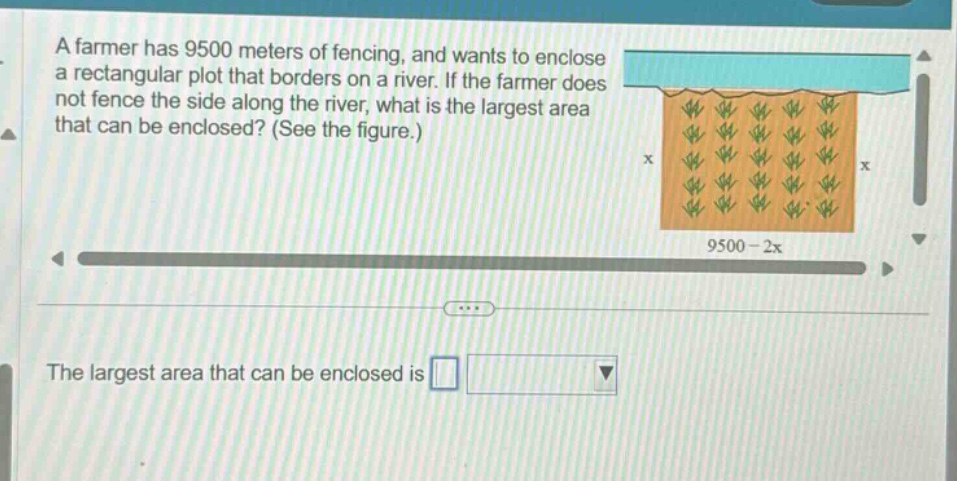
a farmer has 9500 meters of fencing, and wants to enclose a rectangular plot that borders on a river. if the farmer does not fence the side along the river, what is the largest area that can be enclosed? (see the figure.) the largest area that can be enclosed is
Answer
Explanation:
Step1: Define the area function
Let the two equal - length sides perpendicular to the river be $x$ meters each, and the side parallel to the river be $y$ meters. The total length of the fence is $y + 2x=9500$, so $y = 9500 - 2x$. The area $A$ of the rectangle is $A(x)=x\cdot y=x(9500 - 2x)=9500x-2x^{2}$.
Step2: Find the derivative of the area function
Differentiate $A(x)$ with respect to $x$. Using the power rule, if $A(x)=9500x - 2x^{2}$, then $A^\prime(x)=\frac{d}{dx}(9500x)-\frac{d}{dx}(2x^{2})=9500 - 4x$.
Step3: Find the critical points
Set $A^\prime(x) = 0$ to find the critical points. So, $9500 - 4x=0$. Solving for $x$ gives $4x = 9500$, and $x=\frac{9500}{4}=2375$.
Step4: Determine the nature of the critical point
Differentiate $A^\prime(x)$ to get the second - derivative $A^{\prime\prime}(x)=\frac{d}{dx}(9500 - 4x)=-4<0$. Since $A^{\prime\prime}(x)<0$ when $x = 2375$, the function $A(x)$ has a maximum at $x = 2375$.
Step5: Calculate the maximum area
Substitute $x = 2375$ into the area function $A(x)$. $A(2375)=2375\times(9500 - 2\times2375)=2375\times(9500 - 4750)=2375\times4750 = 11281250$ square meters.
Answer:
$11281250$ square meters