what are the features of the function f(x)=log₂x + 6 graphed below? answer the function f(x) is function…
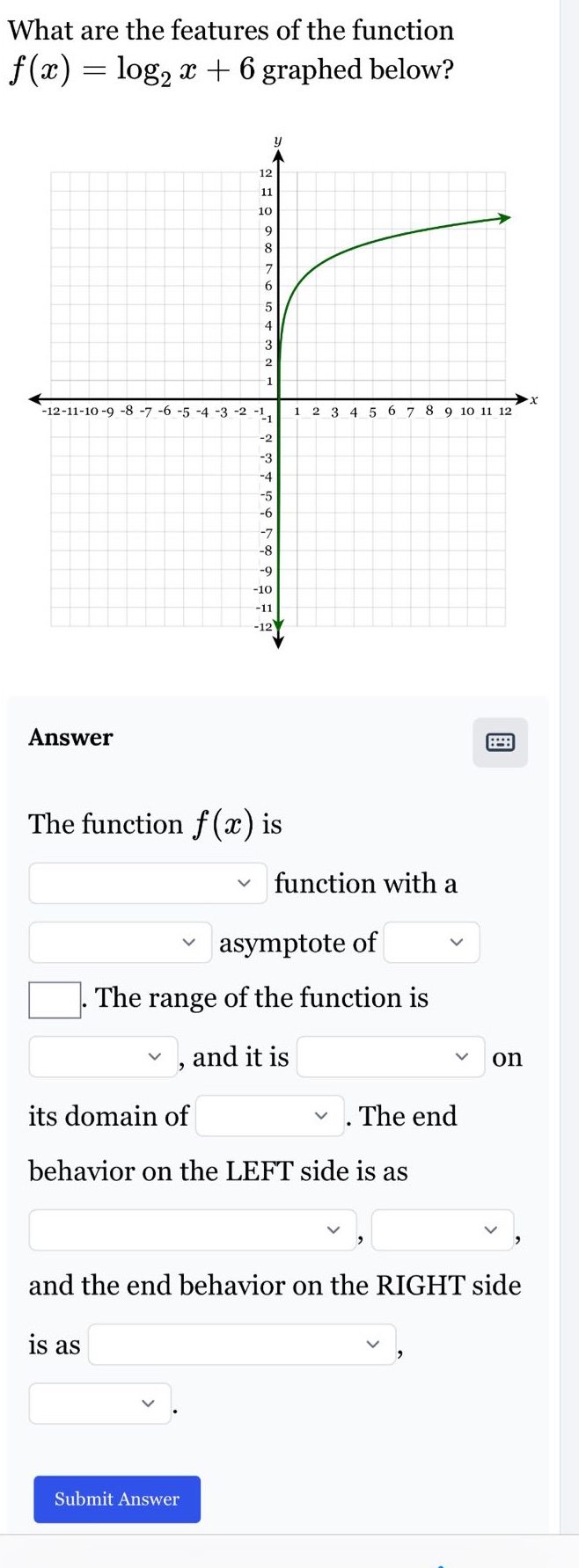
what are the features of the function f(x)=log₂x + 6 graphed below? answer the function f(x) is function with a asymptote of . the range of the function is , and it is on its domain of . the end behavior on the left side is as , , and the end behavior on the right side is as , .
Answer
Explanation:
Step1: Determine function type
The function $f(x)=\log_2x + 6$ is a logarithmic function. Log - arithmic functions of the form $y = \log_a x$ ($a>0,a\neq1$) have certain characteristic features.
Step2: Find the vertical asymptote
For the function $y=\log_2x + 6$, the vertical asymptote of the basic logarithmic function $y = \log_2x$ is $x = 0$. Shifting the function up by 6 units does not change the vertical asymptote. So the vertical asymptote is $x = 0$.
Step3: Determine the domain
The argument of the logarithm must be positive. For $y=\log_2x+6$, we need $x>0$. So the domain is $(0,\infty)$.
Step4: Determine the range
The range of the basic logarithmic function $y=\log_2x$ is $(-\infty,\infty)$. Shifting the function up by 6 units does not change the range. So the range is $(-\infty,\infty)$.
Step5: Analyze the increasing - decreasing nature
The base of the logarithm $a = 2>1$, so the function $y=\log_2x+6$ is an increasing function on its domain $(0,\infty)$.
Step6: Analyze end - behavior
On the left - hand side, as $x\to0^{+}$, $\log_2x\to-\infty$, so $f(x)=\log_2x + 6\to-\infty$. On the right - hand side, as $x\to\infty$, $\log_2x\to\infty$, so $f(x)=\log_2x + 6\to\infty$.
Answer:
The function $f(x)$ is a logarithmic function with a vertical asymptote of $x = 0$. The range of the function is $(-\infty,\infty)$, and it is increasing on its domain of $(0,\infty)$. The end - behavior on the LEFT side is as $x\to0^{+}$, $f(x)\to-\infty$, and the end - behavior on the RIGHT side is as $x\to\infty$, $f(x)\to\infty$.