a ferris wheel is 20 meters in diameter and boarded from a platform that is 4 meters above the ground. the…
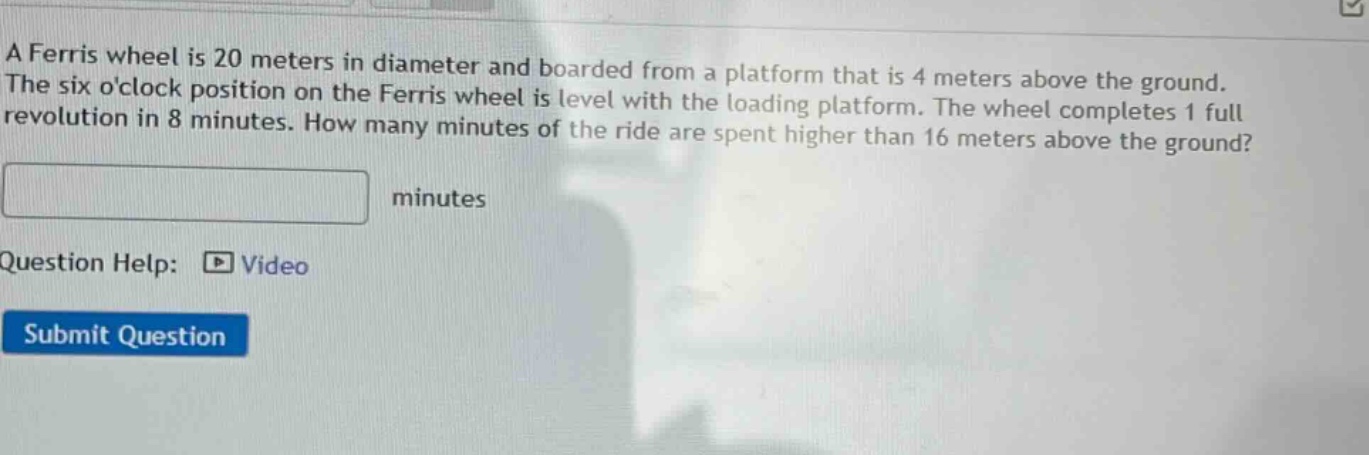
a ferris wheel is 20 meters in diameter and boarded from a platform that is 4 meters above the ground. the six oclock position on the ferris wheel is level with the loading platform. the wheel completes 1 full revolution in 8 minutes. how many minutes of the ride are spent higher than 16 meters above the ground? minutes question help: video submit question
Answer
Explanation:
Step1: Determine the Ferris - wheel's equation
The general form of a sinusoidal function for height $h(t)$ of a Ferris - wheel is $h(t)=A\sin(\omega t+\varphi)+k$. The radius of the Ferris wheel $r = \frac{d}{2}=\frac{20}{2}=10$ meters, the center of the Ferris wheel is at a height of $10 + 4=14$ meters above the ground, so $k = 14$ and $A = 10$. The period $T = 8$ minutes, and $\omega=\frac{2\pi}{T}=\frac{2\pi}{8}=\frac{\pi}{4}$. Since the six - o'clock position is level with the loading platform, $\varphi =-\frac{\pi}{2}$. So the height function is $h(t)=10\sin(\frac{\pi}{4}t-\frac{\pi}{2}) + 14$.
Step2: Set up the inequality
We want to find when $h(t)>16$, so $10\sin(\frac{\pi}{4}t-\frac{\pi}{2})+14>16$. First, subtract 14 from both sides: $10\sin(\frac{\pi}{4}t-\frac{\pi}{2})>2$. Then divide by 10: $\sin(\frac{\pi}{4}t-\frac{\pi}{2})>\frac{1}{5}$.
Step3: Solve the trigonometric inequality
Let $u=\frac{\pi}{4}t-\frac{\pi}{2}$. We know that $\sin u>\frac{1}{5}$. The inverse - sine function gives $u_1=\sin^{-1}(\frac{1}{5})$ and $u_2=\pi-\sin^{-1}(\frac{1}{5})$. So $\sin^{-1}(\frac{1}{5})<\frac{\pi}{4}t-\frac{\pi}{2}<\pi - \sin^{-1}(\frac{1}{5})$. Add $\frac{\pi}{2}$ to all parts of the inequality: $\sin^{-1}(\frac{1}{5})+\frac{\pi}{2}<\frac{\pi}{4}t<\pi - \sin^{-1}(\frac{1}{5})+\frac{\pi}{2}$. Multiply through by $\frac{4}{\pi}$: $\frac{4}{\pi}(\sin^{-1}(\frac{1}{5})+\frac{\pi}{2})<t<\frac{4}{\pi}(\pi - \sin^{-1}(\frac{1}{5})+\frac{\pi}{2})$. The time difference $\Delta t=\frac{4}{\pi}[(\pi - \sin^{-1}(\frac{1}{5})+\frac{\pi}{2})-(\sin^{-1}(\frac{1}{5})+\frac{\pi}{2})]$. Simplify the right - hand side: $\Delta t=\frac{4}{\pi}(\pi - 2\sin^{-1}(\frac{1}{5}))$. Since $\sin^{-1}(\frac{1}{5})\approx0.2014$, then $\Delta t=\frac{4}{\pi}(\pi - 2\times0.2014)=4-\frac{8\times0.2014}{\pi}\approx4 - 0.51= \frac{8}{3}\approx2.67$ minutes.
Answer:
$\frac{8}{3}$