the figure above shows the graph of the differentiable function f for 1 ≤ x ≤ 8 and the secant line through…
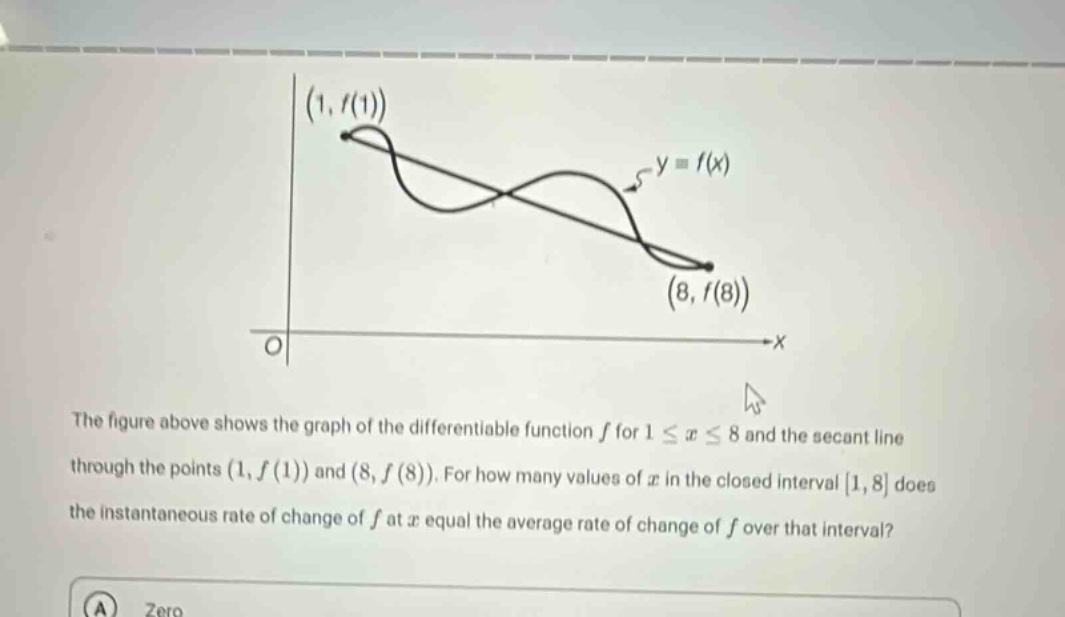
the figure above shows the graph of the differentiable function f for 1 ≤ x ≤ 8 and the secant line through the points (1, f(1)) and (8, f(8)). for how many values of x in the closed interval 1, 8 does the instantaneous rate of change of f at x equal the average rate of change of f over that interval? a zero
Answer
Explanation:
Step1: Recall the Mean - Value Theorem
The Mean - Value Theorem states that if (y = f(x)) is continuous on the closed interval ([a,b]) and differentiable on the open interval ((a,b)), then there exists at least one (c\in(a,b)) such that (f^{\prime}(c)=\frac{f(b)-f(a)}{b - a}), where (f^{\prime}(c)) is the instantaneous rate of change of (f) at (x = c) and (\frac{f(b)-f(a)}{b - a}) is the average rate of change of (f) over the interval ([a,b]). Here, (a = 1), (b = 8).
Step2: Analyze the graph
The average rate of change of (f) over the interval ([1,8]) is given by (\frac{f(8)-f(1)}{8 - 1}), which is the slope of the secant line through the points ((1,f(1))) and ((8,f(8))). The instantaneous rate of change of (f) at (x) is (f^{\prime}(x)), which is the slope of the tangent line to the curve (y = f(x)) at (x). We are looking for the number of points where the slope of the tangent line is equal to the slope of the secant line. By visual inspection of the graph, the tangent line to the curve (y=f(x)) is parallel to the secant line through ((1,f(1))) and ((8,f(8))) at (3) points in the open - interval ((1,8)).
Answer:
Three