1. the figure shows the graph of the increasing function ( f ) on its domain of all real numbers ( x>2 )…
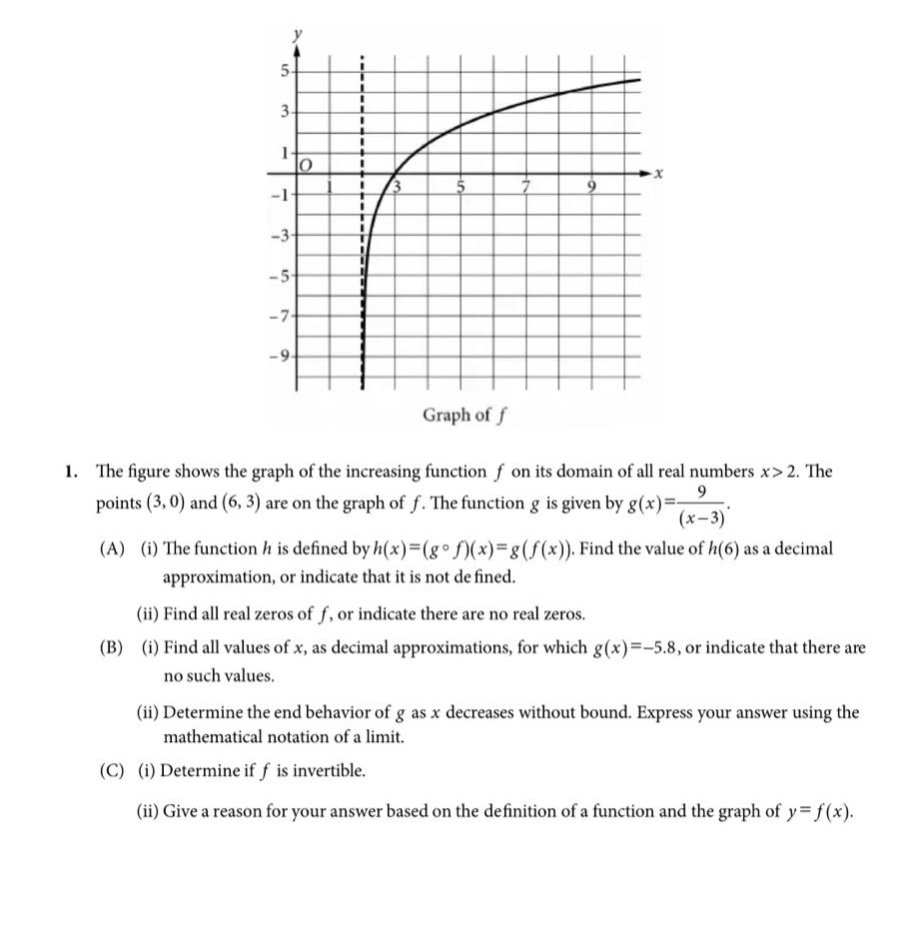
1. the figure shows the graph of the increasing function ( f ) on its domain of all real numbers ( x>2 ). the points ( (3,0) ) and ( (6,3) ) are on the graph of ( f ). the function ( g ) is given by ( g(x)=\frac{9}{(x - 3)} ).\n(a) (i) the function ( h ) is defined by ( h(x)=(gcirc f)(x)=g(f(x)) ). find the value of ( h(6) ) as a decimal approximation, or indicate that it is not defined.\n(ii) find all real zeros of ( f ), or indicate there are no real zeros.\n(b) (i) find all values of ( x ), as decimal approximations, for which ( g(x)=-5.8 ), or indicate that there are no such values.\n(ii) determine the end - behavior of ( g ) as ( x ) decreases without bound. express your answer using the mathematical notation of a limit.\n(c) (i) determine if ( f ) is invertible.\n(ii) give a reason for your answer based on the definition of a function and the graph of ( y = f(x) ).
Answer
Explanation:
Step1: Find (h(6))
First, find (f(6)). Since the point ((6,3)) is on the graph of (f), (f(6)=3). Then, find (h(6)=g(f(6))). Substitute (f(6) = 3) into (g(x)=\frac{9}{x - 3}), we get (g(3)=\frac{9}{3-3}), which is undefined.
Step2: Find real - zeros of (f)
The real - zeros of (f) are the (x) values for which (f(x)=0). The point ((3,0)) is on the graph of (f), so (x = 3) is a real zero of (f).
Step3: Solve (g(x)=-5.8)
Set (g(x)=\frac{9}{x - 3}=-5.8). Cross - multiply: (9=-5.8(x - 3)). Expand: (9=-5.8x+17.4). Rearrange: (5.8x=17.4 - 9), (5.8x = 8.4), then (x=\frac{8.4}{5.8}\approx1.45). But the domain of (g) is (x\neq3) and this value is in the domain.
Step4: Determine end - behavior of (g) as (x\to-\infty)
We find (\lim_{x\to-\infty}g(x)=\lim_{x\to-\infty}\frac{9}{x - 3}). As (x\to-\infty), the denominator (x-3\to-\infty), so (\lim_{x\to-\infty}\frac{9}{x - 3}=0).
Step5: Determine if (f) is invertible
A function (y = f(x)) is invertible if it is one - to - one. Since (f) is an increasing function on its domain (x>2), for any (x_1,x_2\in(2,\infty)) with (x_1\neq x_2), we have (f(x_1)\neq f(x_2)). So (f) is one - to - one and thus invertible.
Step6: Give reason for invertibility
By the definition of a one - to - one function, an increasing function on an interval has a unique output for each input. Looking at the graph of (y = f(x)), as (x) increases, (y) increases, and no two different (x) values have the same (y) value.
Answer:
(A) (i) Undefined (ii) (x = 3) (B) (i) (x\approx1.45) (ii) (\lim_{x\to-\infty}g(x)=0) (C) (i) Yes (ii) (f) is an increasing function on its domain (x > 2), so it is one - to - one.