the figure shows the graph of the polar function r = f(θ), where f(θ)=4cos(2θ), in the polar coordinate…
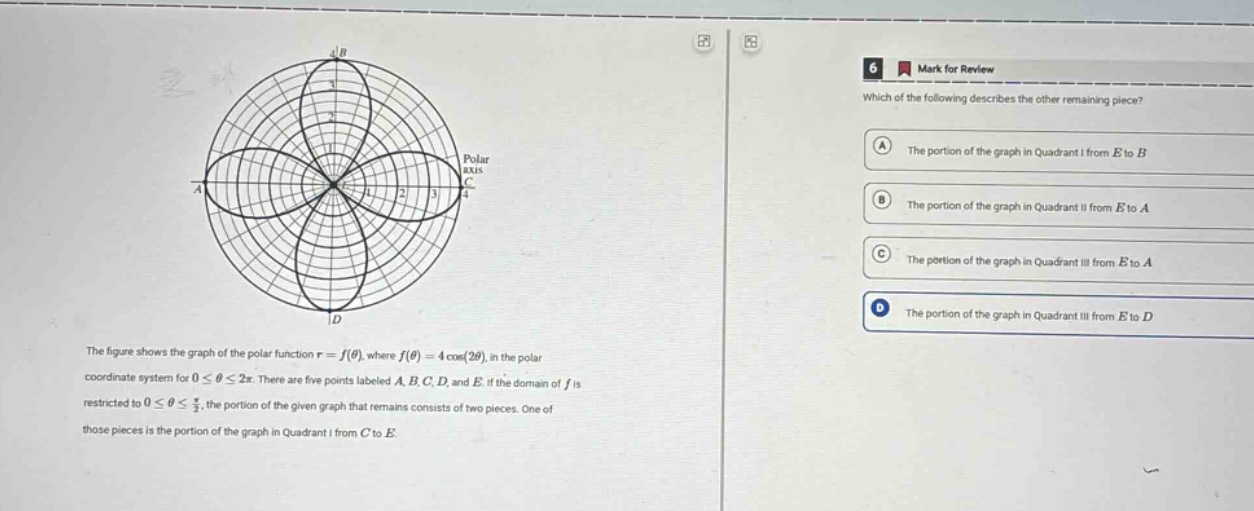
the figure shows the graph of the polar function r = f(θ), where f(θ)=4cos(2θ), in the polar coordinate system for 0≤θ≤2π. there are five points labeled a, b, c, d, and e. if the domain of f is restricted to 0≤θ≤π/2, the portion of the given graph that remains consists of two pieces. one of those pieces is the portion of the graph in quadrant i from c to e. 6 mark for review which of the following describes the other remaining piece? a the portion of the graph in quadrant i from e to b b the portion of the graph in quadrant ii from e to a c the portion of the graph in quadrant iii from e to a d the portion of the graph in quadrant iii from e to d
Answer
Explanation:
Step1: Analyze polar function symmetry
The polar function $r = 4\cos(2\theta)$ is symmetric about the polar - axis ($\theta = 0$) and the lines $\theta=\frac{\pi}{2},\theta=\pi,\theta=\frac{3\pi}{2}$. When the domain is restricted to $0\leq\theta\leq\frac{\pi}{2}$, we know that the graph of $r = 4\cos(2\theta)$ has symmetry properties. The function $y = \cos(2\theta)$ has a period of $\pi$. In polar coordinates, for $r = 4\cos(2\theta)$, when $\theta$ ranges from $0$ to $\frac{\pi}{2}$, the graph is symmetric about the line $\theta=\frac{\pi}{4}$.
Step2: Determine the remaining piece
Since one piece is in Quadrant I from $C$ to $E$, due to the symmetry of the four - petal rose curve $r = 4\cos(2\theta)$ about the line $\theta=\frac{\pi}{4}$ in the domain $0\leq\theta\leq\frac{\pi}{2}$, the other piece must be in Quadrant II from $E$ to $A$.
Answer:
B. The portion of the graph in Quadrant II from $E$ to $A$