3. the figure shows two wing positions of a bird in flight. point s is on the tip of the wing, and point x…
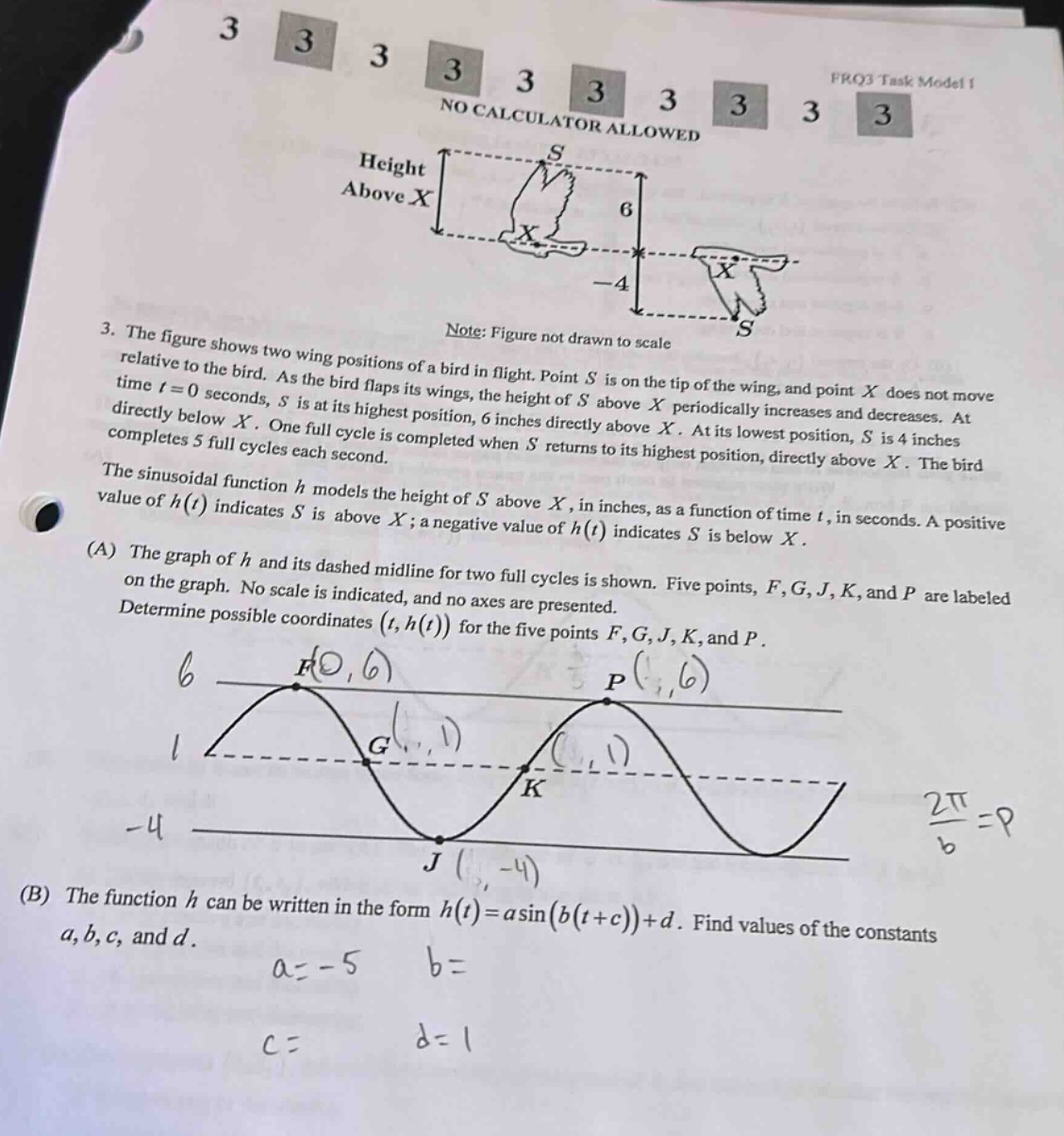
3. the figure shows two wing positions of a bird in flight. point s is on the tip of the wing, and point x does not move relative to the bird. as the bird flaps its wings, the height of s above x periodically increases and decreases. at time t = 0 seconds, s is at its highest position, 6 inches directly above x. at its lowest position, s is 4 inches directly below x. one full cycle is completed when s returns to its highest position, directly above x. the bird completes 5 full cycles each second. the sinusoidal function h models the height of s above x, in inches, as a function of time t, in seconds. a positive value of h(t) indicates s is above x; a negative value of h(t) indicates s is below x. (a) the graph of h and its dashed mid - line for two full cycles is shown. five points, f, g, j, k, and p are labeled on the graph. no scale is indicated, and no axes are presented. determine possible coordinates (t, h(t)) for the five points f, g, j, k, and p. (b) the function h can be written in the form h(t)=a sin(b(t + c))+d. find values of the constants a, b, c, and d.
Answer
Explanation:
Step1: Determine the amplitude
The amplitude $a$ is half the distance between the maximum and minimum values. The maximum value of $h(t)$ is $6$ and the minimum is $- 4$. So, $a=\frac{6 - (-4)}{2}=\frac{10}{2}=5$. Since the function starts at a maximum (at $t = 0$) and the standard - form is $y=a\sin(b(t + c))+d$, and for a sine function starting at a maximum we use $a=- 5$ (to account for the phase - shift to make it start at a max).
Step2: Determine the period and $b$
The bird completes $5$ full cycles each second. The period $T$ is the time for one cycle. So, $T=\frac{1}{5}$ seconds. The formula for the period of a sine function is $T=\frac{2\pi}{b}$. Substituting $T=\frac{1}{5}$ into the formula, we get $\frac{1}{5}=\frac{2\pi}{b}$, then $b = 10\pi$.
Step3: Determine the vertical shift $d$
The vertical shift $d$ is the mid - line of the function. The mid - line is $d=\frac{6+( - 4)}{2}=\frac{6 - 4}{2}=1$.
Step4: Determine the phase - shift $c$
Since the function starts at a maximum at $t = 0$ for the form $h(t)=a\sin(b(t + c))+d$, and for $y = \sin x$ the maximum occurs at $x=\frac{\pi}{2}+2k\pi,k\in\mathbb{Z}$. For $y=-5\sin(10\pi(t + c)) + 1$, when $t = 0$, we want $10\pi(0 + c)=\frac{\pi}{2}+2k\pi$. Solving for $c$, we get $c=\frac{1}{20}$.
Coordinates of points:
- Point $F$: Since the function starts at its maximum at $t = 0$ and the maximum value of $h(t)$ is $6$, the coordinates of $F$ are $(0,6)$.
- Point $G$: A quarter - cycle after the start, the period $T=\frac{1}{5}$ seconds, a quarter - cycle is $\frac{T}{4}=\frac{1}{20}$ seconds. The mid - line value is $1$, so the coordinates of $G$ are $(\frac{1}{20},1)$.
- Point $J$: A half - cycle after the start ($t=\frac{T}{2}=\frac{1}{10}$ seconds), the minimum value of $h(t)$ is $-4$, so the coordinates of $J$ are $(\frac{1}{10},-4)$.
- Point $K$: Three - quarters of a cycle after the start ($t=\frac{3T}{4}=\frac{3}{20}$ seconds), the mid - line value is $1$, so the coordinates of $K$ are $(\frac{3}{20},1)$.
- Point $P$: One full cycle after the start ($t = \frac{1}{5}$ seconds), the maximum value of $h(t)$ is $6$, so the coordinates of $P$ are $(\frac{1}{5},6)$.
Answer:
(A) $F(0,6),G(\frac{1}{20},1),J(\frac{1}{10},-4),K(\frac{3}{20},1),P(\frac{1}{5},6)$ (B) $a=-5,b = 10\pi,c=\frac{1}{20},d = 1$