the figure shows the velocity of an object for 0 ≤ t ≤ 8. calculate the following estimates of the distance…
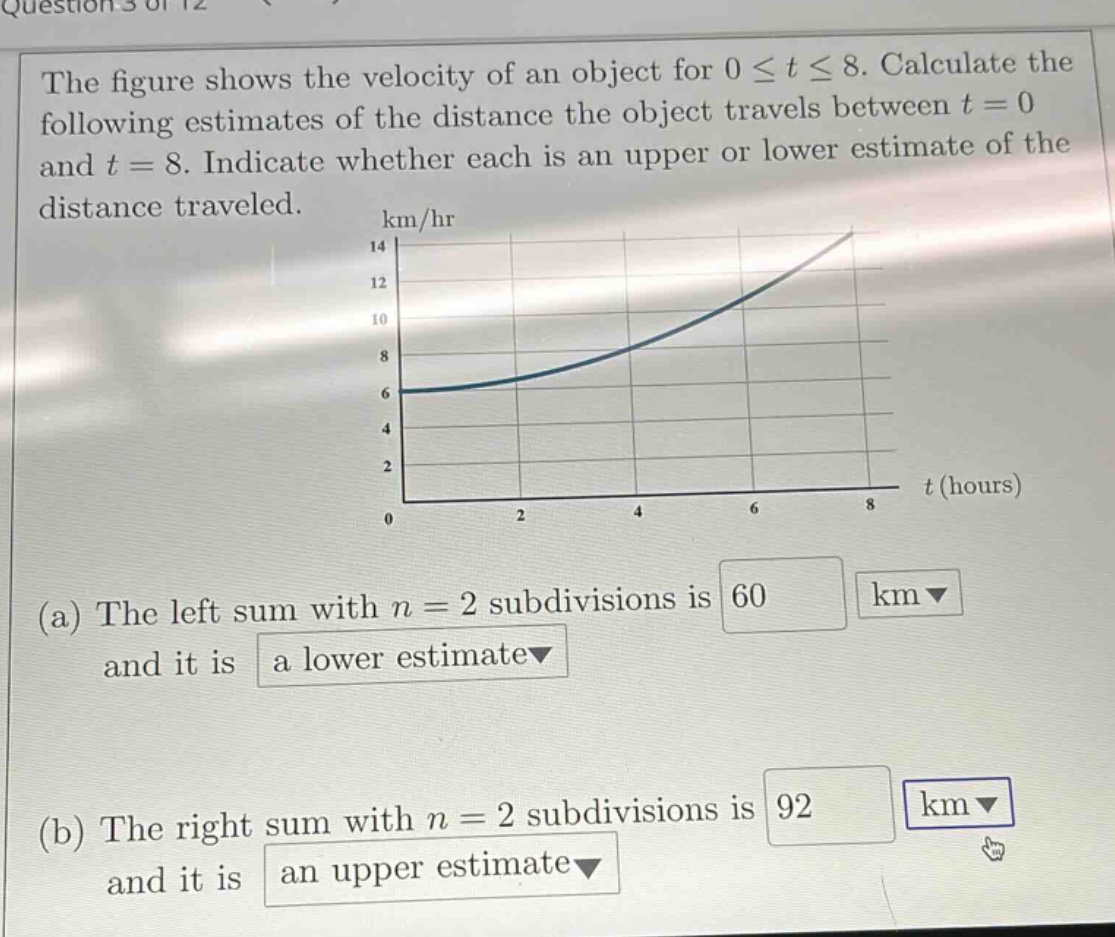
the figure shows the velocity of an object for 0 ≤ t ≤ 8. calculate the following estimates of the distance the object travels between t = 0 and t = 8. indicate whether each is an upper or lower estimate of the distance traveled. (a) the left sum with n = 2 subdivisions is 60 km and it is a lower estimate (b) the right sum with n = 2 subdivisions is 92 km and it is an upper estimate
Answer
Explanation:
Step1: Recall left - sum and right - sum formulas
The left - sum $L_n=\sum_{i = 0}^{n - 1}v(t_i)\Delta t$ and the right - sum $R_n=\sum_{i = 1}^{n}v(t_i)\Delta t$, where $\Delta t=\frac{b - a}{n}$, $a = 0$, $b = 8$ and $n = 2$, so $\Delta t=\frac{8-0}{2}=4$.
Step2: Find velocities for left - sum
For the left - sum with $n = 2$ on the interval $[0,8]$, the sub - intervals are $[0,4]$ and $[4,8]$. The left - hand endpoints are $t_0 = 0$ and $t_1=4$. From the graph, $v(0)=6$ and $v(4)=9$. Then $L_2=v(0)\times4 + v(4)\times4=6\times4+9\times4=(6 + 9)\times4=60$ km. Since the function $v(t)$ is increasing, the left - sum is a lower estimate.
Step3: Find velocities for right - sum
For the right - sum with $n = 2$ on the interval $[0,8]$, the right - hand endpoints are $t_1 = 4$ and $t_2=8$. From the graph, $v(4)=9$ and $v(8)=14$. Then $R_2=v(4)\times4 + v(8)\times4=9\times4+14\times4=(9 + 14)\times4=92$ km. Since the function $v(t)$ is increasing, the right - sum is an upper estimate.
Answer:
(a) 60 km, a lower estimate (b) 92 km, an upper estimate