1 fill in the blank 2 points the function h(x)=ln(−x + 2)−2 is a transformation of the function f(x)=lnx…
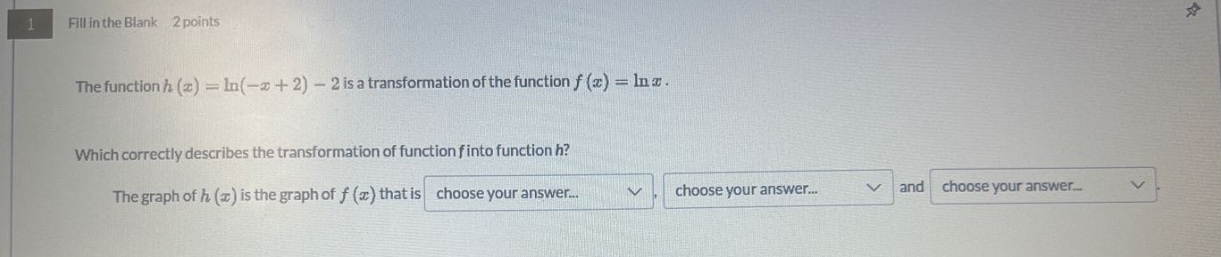
1 fill in the blank 2 points the function h(x)=ln(−x + 2)−2 is a transformation of the function f(x)=lnx. which correctly describes the transformation of function f into function h? the graph of h(x) is the graph of f(x) that is choose your answer... choose your answer... and choose your answer...
Answer
Explanation:
Step1: Analyze horizontal transformation
For the function $y = f(x)$ to $y=f(-x + c)$, the graph is reflected about the y - axis and shifted $c$ units to the right. Here, from $f(x)=\ln x$ to $\ln(-x + 2)$, we first consider the $-x$ part which reflects the graph of $y = \ln x$ about the y - axis, and then the $+2$ inside the logarithm shifts the reflected graph 2 units to the right.
Step2: Analyze vertical transformation
For the function $y = f(x)$ to $y=f(x)-d$, the graph is shifted $d$ units downwards. Here, from $\ln(-x + 2)$ to $\ln(-x + 2)-2$, the graph is shifted 2 units downwards.
Answer:
Reflected about the y - axis, shifted 2 units to the right, shifted 2 units downwards.