fill in each blank so that the resulting statement is true. the solution of tan x = -√3 in 0,π) is x = π…
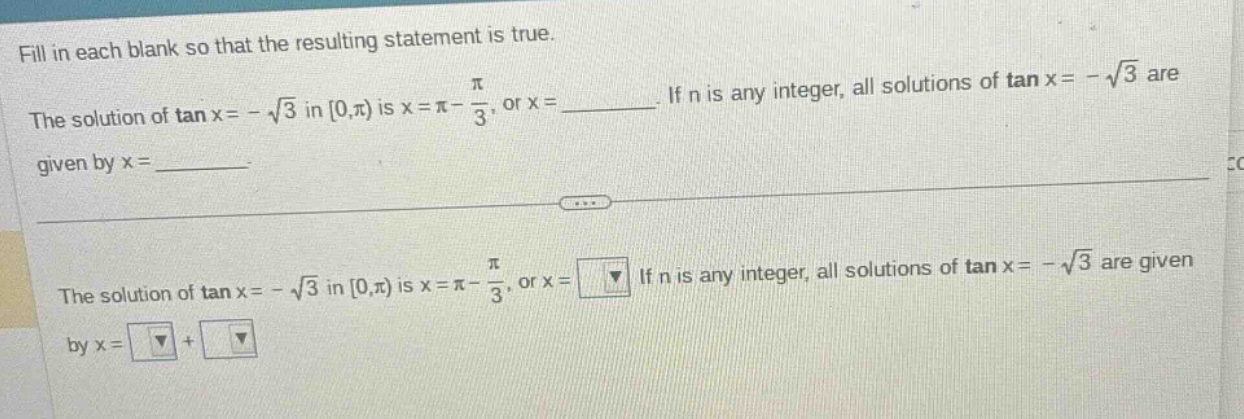
fill in each blank so that the resulting statement is true. the solution of tan x = -√3 in 0,π) is x = π - π/3, or x = ____. if n is any integer, all solutions of tan x = -√3 are given by x = ____. the solution of tan x = -√3 in 0,π) is x = π - π/3, or x = ▼ if n is any integer, all solutions of tan x = -√3 are given by x = ▼ + ▼
Answer
Explanation:
Step1: Recall tangent - function properties
The tangent function (y = \tan x) has a period of (\pi). We know that (\tan\frac{\pi}{3}=\sqrt{3}), and (\tan x) is negative in the second and fourth quadrants. In the interval ([0,\pi]), if (\tan x=-\sqrt{3}), one solution is (x = \pi-\frac{\pi}{3}=\frac{2\pi}{3}).
Step2: Find the general solution
Since the period of (y = \tan x) is (\pi), if (x_0) is a solution of (\tan x = k), then the general solution is given by (x=x_0 + n\pi), where (n\in\mathbb{Z}). For (\tan x=-\sqrt{3}) and a particular - solution (x=\frac{2\pi}{3}), the general solution is (x=\frac{2\pi}{3}+n\pi).
Answer:
The first blank: (\frac{2\pi}{3}); The second blank: (\frac{2\pi}{3}+n\pi)