final exam\n90 points possible answered: 17/19\nquestion 18\nconsider the function ( p(x)=x^{3}+11 x^{2}+30…
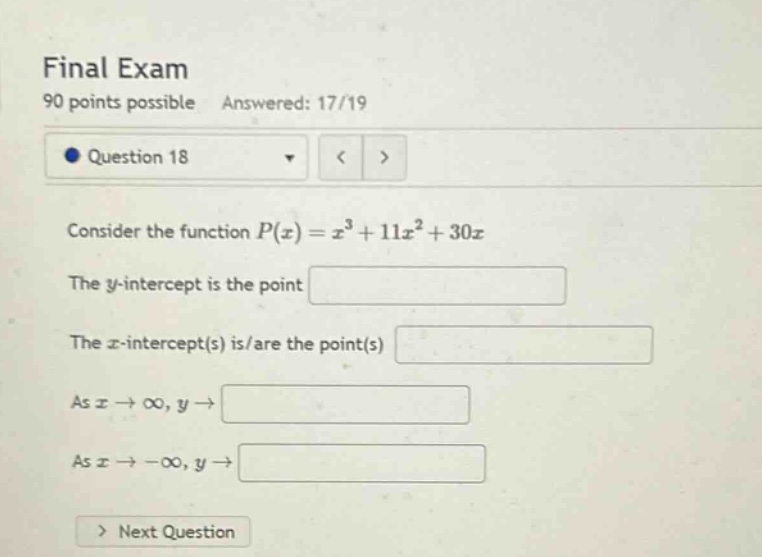
final exam\n90 points possible answered: 17/19\nquestion 18\nconsider the function ( p(x)=x^{3}+11 x^{2}+30 x )\nthe ( y )-intercept is the point\nthe ( x )-intercept(s) is/are the point(s)\nas ( x \rightarrow infty, y \rightarrow )\nas ( x \rightarrow-infty, y \rightarrow )\nnext question
Answer
Explanation:
Step1: Find the (y -)intercept
The (y -)intercept occurs when (x = 0). Substitute (x=0) into (P(x)=x^{3}+11x^{2}+30x). [P(0)=0^{3}+11\times0^{2}+30\times0 = 0] So the (y -)intercept is the point ((0,0)).
Step2: Find the (x -)intercepts
The (x -)intercepts occur when (y = P(x)=0). So we solve the equation (x^{3}+11x^{2}+30x=0). Factor out an (x): (x(x^{2}+11x + 30)=0). Factor the quadratic (x^{2}+11x + 30=(x + 5)(x+6)). So the equation becomes (x(x + 5)(x + 6)=0). Set each factor equal to zero: (x=0) or (x+5=0) (i.e., (x=-5)) or (x + 6=0) (i.e., (x=-6)). The (x -)intercepts are the points ((0,0)), ((-5,0)), ((-6,0)).
Step3: Determine the end - behavior as (x\to\infty)
For a polynomial function (P(x)=a_{n}x^{n}+a_{n - 1}x^{n-1}+\cdots+a_{1}x+a_{0}), the leading term is (a_{n}x^{n}). Here (P(x)=x^{3}+11x^{2}+30x), (n = 3) (odd) and (a_{n}=1>0). As (x\to\infty), (y=x^{3}(1+\frac{11}{x}+\frac{30}{x^{2}})\to\infty) (since for large (x), (\frac{11}{x}\to0) and (\frac{30}{x^{2}}\to0))
Step4: Determine the end - behavior as (x\to-\infty)
Since (n = 3) (odd) and (a_{n}=1>0). As (x\to-\infty), (y=x^{3}(1+\frac{11}{x}+\frac{30}{x^{2}})\to-\infty) (since for large (|x|) negative, (x^{3}) is negative and (\frac{11}{x}\to0), (\frac{30}{x^{2}}\to0))
Answer:
- The (y -)intercept is the point ((0,0))
- The (x -)intercepts are the points ((0,0)), ((-5,0)), ((-6,0))
- As (x\to\infty), (y\to\infty)
- As (x\to-\infty), (y\to-\infty)