final exam review test questions part 1 of 1 - question 27 of 50 2 points use the first derivative test to…
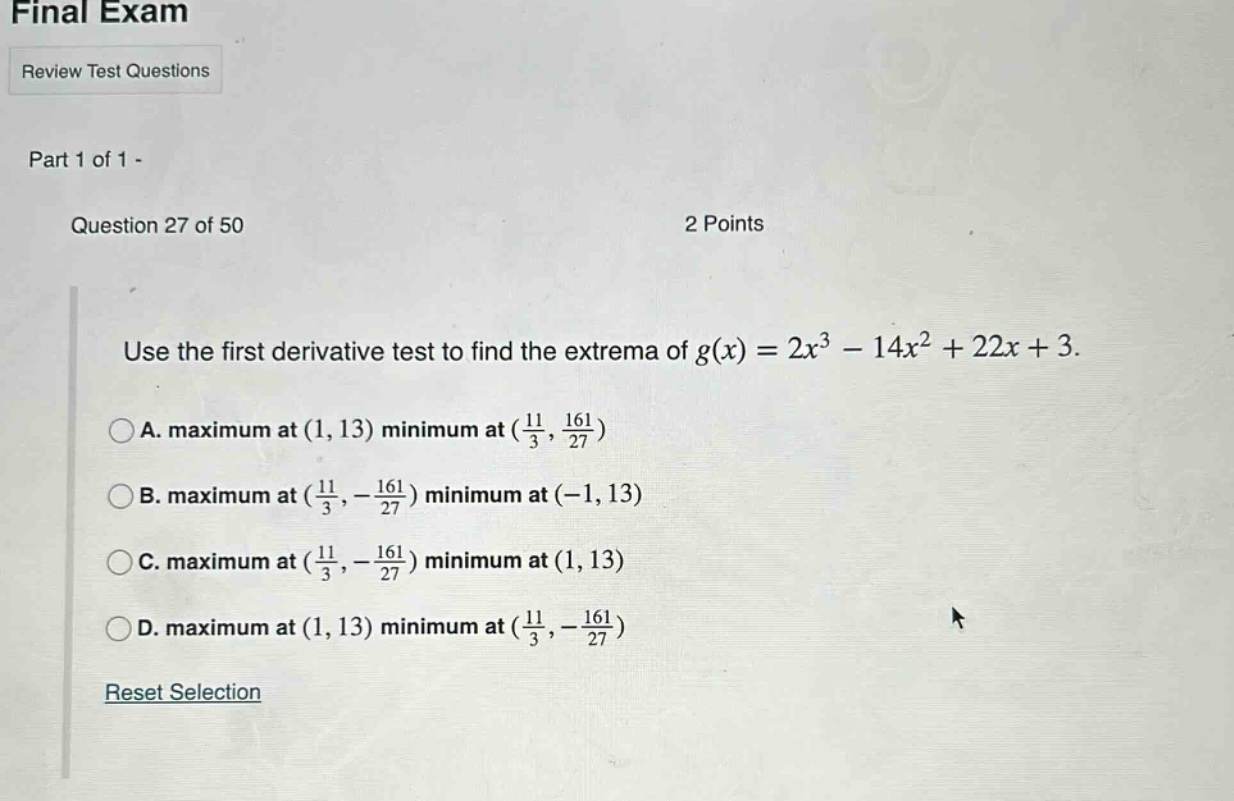
final exam review test questions part 1 of 1 - question 27 of 50 2 points use the first derivative test to find the extrema of g(x)=2x³ - 14x² + 22x + 3. a. maximum at (1, 13) minimum at (11/3, 161/27) b. maximum at (11/3, -161/27) minimum at (-1, 13) c. maximum at (11/3, -161/27) minimum at (1, 13) d. maximum at (1, 13) minimum at (11/3, -161/27) reset selection
Answer
Explanation:
Step1: Find the first - derivative
Differentiate $g(x)=2x^{3}-14x^{2}+22x + 3$ using the power rule. $g^\prime(x)=6x^{2}-28x + 22$.
Step2: Set the first - derivative equal to zero
$6x^{2}-28x + 22 = 0$. Divide through by 2: $3x^{2}-14x + 11 = 0$. Factor: $(3x - 11)(x - 1)=0$. Solve for $x$: $x = 1$ or $x=\frac{11}{3}$.
Step3: Use the first - derivative test
Choose test points in the intervals $(-\infty,1)$, $(1,\frac{11}{3})$, and $(\frac{11}{3},\infty)$. Let's choose $x = 0$, $x = 2$, and $x = 4$. $g^\prime(0)=6(0)^{2}-28(0)+22=22>0$, so $g(x)$ is increasing on $(-\infty,1)$. $g^\prime(2)=6(2)^{2}-28(2)+22=24 - 56+22=-10<0$, so $g(x)$ is decreasing on $(1,\frac{11}{3})$. $g^\prime(4)=6(4)^{2}-28(4)+22=96 - 112+22=6>0$, so $g(x)$ is increasing on $(\frac{11}{3},\infty)$. Since $g(x)$ changes from increasing to decreasing at $x = 1$, there is a maximum at $x = 1$. $g(1)=2(1)^{3}-14(1)^{2}+22(1)+3=2-14 + 22+3=13$. Since $g(x)$ changes from decreasing to increasing at $x=\frac{11}{3}$, there is a minimum at $x=\frac{11}{3}$. $g(\frac{11}{3})=2(\frac{11}{3})^{3}-14(\frac{11}{3})^{2}+22(\frac{11}{3})+3=2\times\frac{1331}{27}-14\times\frac{121}{9}+ \frac{242}{3}+3=\frac{2662}{27}-\frac{1694}{9}+\frac{242}{3}+3=\frac{2662}{27}-\frac{5082}{27}+\frac{2178}{27}+\frac{81}{27}=-\frac{161}{27}$.
Answer:
D. maximum at $(1,13)$ minimum at $(\frac{11}{3},-\frac{161}{27})$