find the absolute maximum and minimum values of the function, f(x)=x^2 + 440/x; (0,∞)
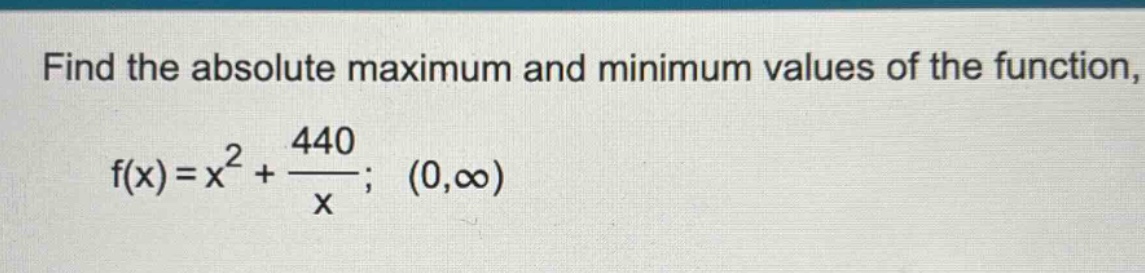
find the absolute maximum and minimum values of the function, f(x)=x^2 + 440/x; (0,∞)
Answer
Explanation:
Step1: Find the derivative
Differentiate $f(x)=x^{2}+\frac{440}{x}=x^{2} + 440x^{-1}$ using power - rule. $f'(x)=2x-440x^{-2}=2x-\frac{440}{x^{2}}=\frac{2x^{3}-440}{x^{2}}$.
Step2: Find critical points
Set $f'(x) = 0$. Then $\frac{2x^{3}-440}{x^{2}}=0$. Since the denominator $x^{2}\neq0$ for $x\in(0,\infty)$, we solve $2x^{3}-440 = 0$. So $x^{3}=220$, and $x = \sqrt[3]{220}$.
Step3: Use the second - derivative test
Differentiate $f'(x)$ to get $f''(x)=2 + 880x^{-3}=2+\frac{880}{x^{3}}$. Substitute $x=\sqrt[3]{220}$ into $f''(x)$: $f''(\sqrt[3]{220})=2+\frac{880}{220}=2 + 4=6>0$. So $f(x)$ has a local minimum at $x=\sqrt[3]{220}$.
Step4: Calculate the minimum value
Substitute $x=\sqrt[3]{220}$ into $f(x)$: $f(\sqrt[3]{220})=(\sqrt[3]{220})^{2}+\frac{440}{\sqrt[3]{220}}=220^{\frac{2}{3}}+220^{\frac{2}{3}}=2\times220^{\frac{2}{3}}$. Since the domain is $(0,\infty)$ and as $x\rightarrow0^{+}$, $f(x)\rightarrow\infty$ and as $x\rightarrow\infty$, $f(x)\rightarrow\infty$, there is no absolute maximum.
Answer:
The absolute minimum value is $2\times220^{\frac{2}{3}}$, and there is no absolute maximum.