find the absolute maximum and minimum values of each function, if they exist, over the indicated interval…
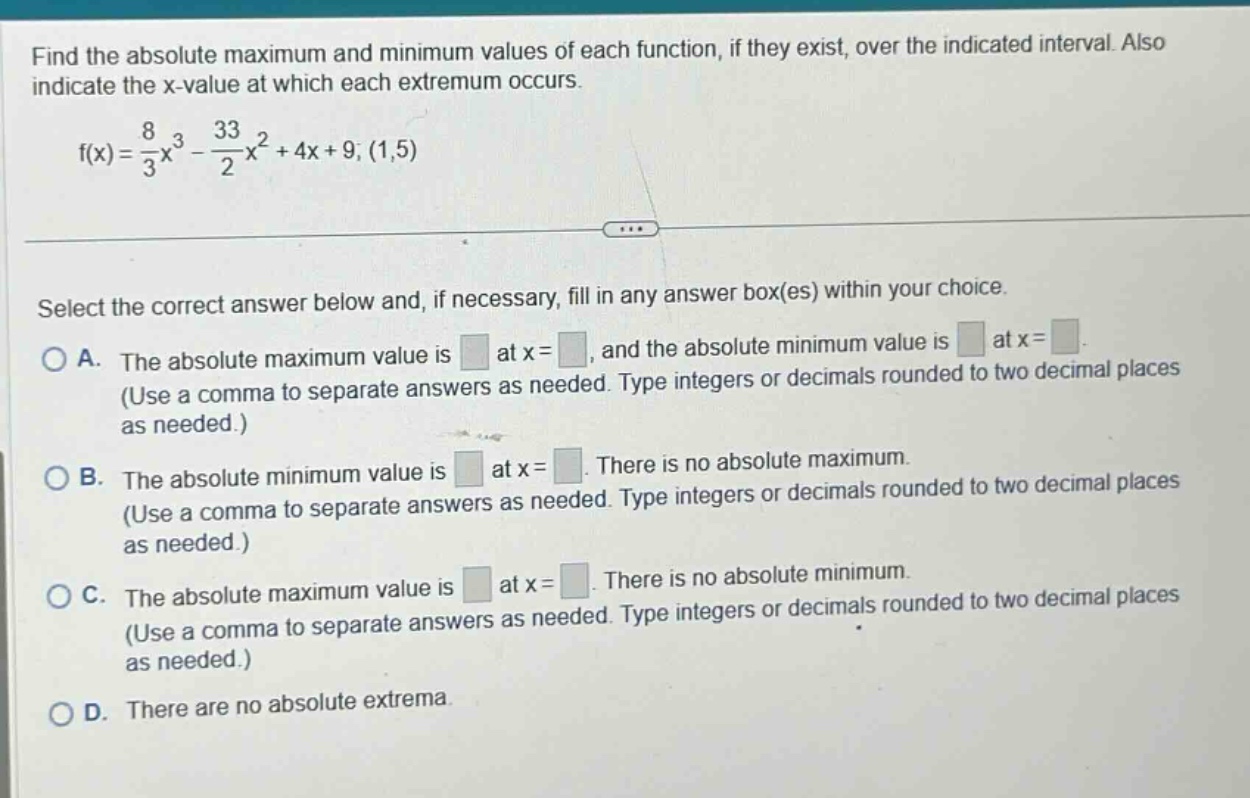
find the absolute maximum and minimum values of each function, if they exist, over the indicated interval. also indicate the x - value at which each extremum occurs. f(x) = 8/3 x^3 - 33/2 x^2 + 4x + 9; (1,5) select the correct answer below and, if necessary, fill in any answer box(es) within your choice. a. the absolute maximum value is at x = , and the absolute minimum value is at x = . (use a comma to separate answers as needed. type integers or decimals rounded to two decimal places as needed.) b. the absolute minimum value is at x = . there is no absolute maximum. (use a comma to separate answers as needed. type integers or decimals rounded to two decimal places as needed.) c. the absolute maximum value is at x = . there is no absolute minimum. (use a comma to separate answers as needed. type integers or decimals rounded to two decimal places as needed.) d. there are no absolute extrema.
Answer
Explanation:
Step1: Find the derivative
Differentiate $f(x)=\frac{8}{3}x^{3}-\frac{33}{2}x^{2}+4x + 9$ using power - rule. $f'(x)=8x^{2}-33x + 4$.
Step2: Solve for critical points
Set $f'(x)=0$, so $8x^{2}-33x + 4 = 0$. Using the quadratic formula $x=\frac{-b\pm\sqrt{b^{2}-4ac}}{2a}$ with $a = 8$, $b=-33$, $c = 4$. $x=\frac{33\pm\sqrt{(-33)^{2}-4\times8\times4}}{2\times8}=\frac{33\pm\sqrt{1089 - 128}}{16}=\frac{33\pm\sqrt{961}}{16}=\frac{33\pm31}{16}$. We get $x=\frac{33 + 31}{16}=4$ and $x=\frac{33-31}{16}=\frac{1}{8}$. But $\frac{1}{8}\notin(1,5)$, so we only consider $x = 4$.
Step3: Evaluate the function at the critical point and endpoints
Evaluate $f(x)$ at $x = 4$: $f(4)=\frac{8}{3}\times4^{3}-\frac{33}{2}\times4^{2}+4\times4 + 9=\frac{8}{3}\times64-\frac{33}{2}\times16 + 16+9=\frac{512}{3}-264 + 16 + 9=\frac{512}{3}-239=\frac{512-717}{3}=-\frac{205}{3}\approx - 68.33$. The interval is $(1,5)$ (open - interval), we don't evaluate at endpoints.
Step4: Determine the extrema
Since $f(x)$ is a continuous function on the open interval $(1,5)$ and we have only one critical point $x = 4$ in the interval, we check the behavior of the function. We can take a test point, say $x=2$. $f'(2)=8\times2^{2}-33\times2 + 4=32-66 + 4=-30<0$, and for $x = 4.5$, $f'(4.5)=8\times(4.5)^{2}-33\times4.5 + 4=8\times20.25-148.5 + 4=162-148.5 + 4=17.5>0$. So $f(x)$ has a local minimum at $x = 4$. There is no absolute maximum on the open interval $(1,5)$.
Answer:
B. The absolute minimum value is $-68.33$ at $x = 4$. There is no absolute maximum.