find the absolute minimum value on (0,∞) for f(x)=x - 1/x + 10/x³. select the correct choice below and, if…
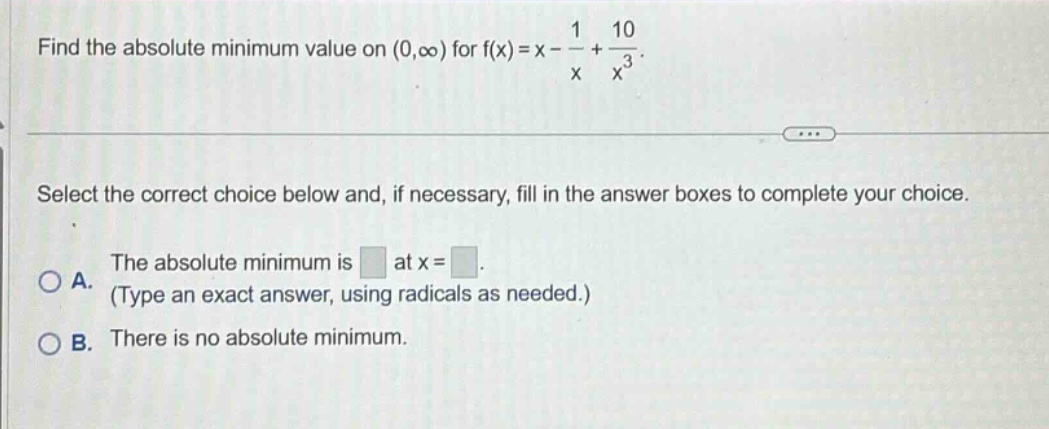
find the absolute minimum value on (0,∞) for f(x)=x - 1/x + 10/x³. select the correct choice below and, if necessary, fill in the answer boxes to complete your choice. a. the absolute minimum is at x = . (type an exact answer, using radicals as needed.) b. there is no absolute minimum.
Answer
Explanation:
Step1: Find the derivative
First, find the derivative of $f(x)=x - \frac{1}{x}+\frac{10}{x^{3}}=x - x^{-1}+10x^{-3}$. Using the power - rule $(x^n)^\prime=nx^{n - 1}$, we have $f^\prime(x)=1+x^{-2}-30x^{-4}=1+\frac{1}{x^{2}}-\frac{30}{x^{4}}$. Let $t = \frac{1}{x^{2}}$, then $f^\prime(x)=1 + t-30t^{2}$.
Step2: Solve for critical points
Set $f^\prime(x) = 0$. So, $1 + t-30t^{2}=0$. Using the quadratic formula for $at^{2}+bt + c = 0$ ($a=-30$, $b = 1$, $c = 1$), $t=\frac{-b\pm\sqrt{b^{2}-4ac}}{2a}=\frac{-1\pm\sqrt{1^{2}-4\times(-30)\times1}}{2\times(-30)}=\frac{-1\pm\sqrt{1 + 120}}{-60}=\frac{-1\pm11}{-60}$. We get $t=\frac{1}{5}$ or $t=-\frac{1}{6}$. Since $t=\frac{1}{x^{2}}\gt0$ for all real $x\neq0$, when $\frac{1}{x^{2}}=\frac{1}{5}$, then $x^{2}=5$, and $x=\sqrt{5}$ (because $x\in(0,\infty)$).
Step3: Find the second - derivative
Find the second - derivative $f^{\prime\prime}(x)=-2x^{-3}+120x^{-5}=-\frac{2}{x^{3}}+\frac{120}{x^{5}}$. Substitute $x = \sqrt{5}$ into $f^{\prime\prime}(x)$: $f^{\prime\prime}(\sqrt{5})=-\frac{2}{(\sqrt{5})^{3}}+\frac{120}{(\sqrt{5})^{5}}=\frac{-2\times\sqrt{5}+120}{25\sqrt{5}}=\frac{-2\sqrt{5}+120}{25\sqrt{5}}\gt0$. So, $f(x)$ has a local minimum at $x = \sqrt{5}$.
Step4: Find the minimum value
Substitute $x=\sqrt{5}$ into $f(x)$: $f(\sqrt{5})=\sqrt{5}-\frac{1}{\sqrt{5}}+\frac{10}{(\sqrt{5})^{3}}=\sqrt{5}-\frac{\sqrt{5}}{5}+\frac{10}{5\sqrt{5}}=\sqrt{5}-\frac{\sqrt{5}}{5}+\frac{2\sqrt{5}}{5}=\frac{5\sqrt{5}-\sqrt{5}+2\sqrt{5}}{5}=\frac{6\sqrt{5}}{5}$.
Answer:
A. The absolute minimum is $\frac{6\sqrt{5}}{5}$ at $x=\sqrt{5}$