find the amplitude, period, and frequency of the sinusoidal function. simplify any fractions. amplitude =…
find the amplitude, period, and frequency of the sinusoidal function. simplify any fractions. amplitude = period = frequency =
Answer
Explanation:
Step1: Find the amplitude
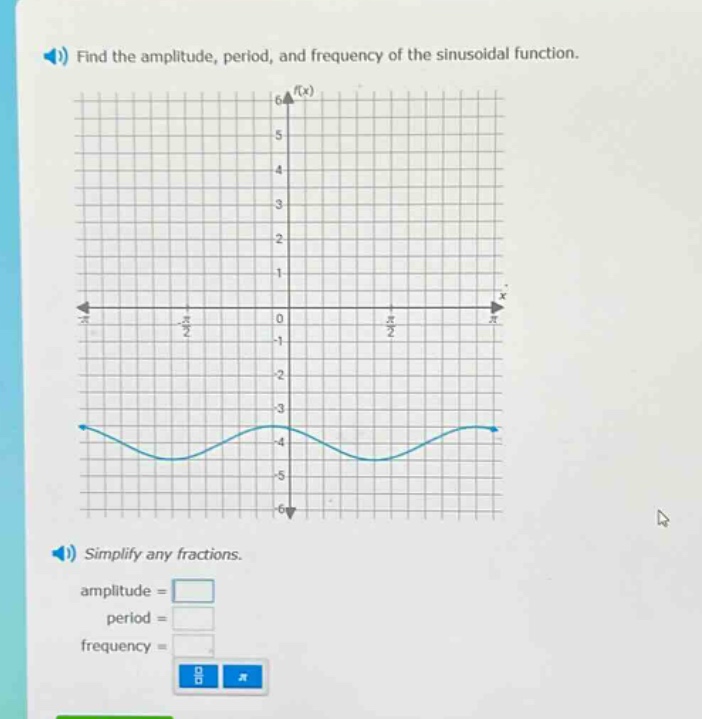
The amplitude (A) of a sinusoidal function (y = A\sin(Bx - C)+D) (or (y=A\cos(Bx - C)+D)) is given by (A=\frac{\text{max}-\text{min}}{2}). From the graph, (\text{max}=- 3), (\text{min}=-5). Then (A=\frac{-3-(-5)}{2}=\frac{-3 + 5}{2}=1).
Step2: Find the period
The general formula for the period (T) of a sinusoidal function (y = A\sin(Bx - C)+D) (or (y = A\cos(Bx - C)+D)) is (T=\frac{2\pi}{|B|}). If we assume the function is of the form (y = A\cos(Bx)+D) (since it has a maximum - like point at (x =-\pi) and is symmetric in a cosine - like way). We can also find the period by looking at the horizontal distance between two consecutive similar points (e.g., two consecutive minima or maxima). The distance between two consecutive minima (or maxima) is (\pi). So, using the formula (T=\frac{2\pi}{|B|}), if (T = \pi), then (\pi=\frac{2\pi}{|B|}), which gives (|B| = 2).
Step3: Find the frequency
The frequency (f) of a sinusoidal function is related to the period by the formula (f=\frac{1}{T}). Since (T=\pi), then (f=\frac{1}{\pi}).
Answer:
amplitude (=1), period (=\pi), frequency (=\frac{1}{\pi})