find the antiderivative for each function when c equals 0. a. f(x)=3^x b. g(x)=7^(-x) c. h(x)=(7/5)^x
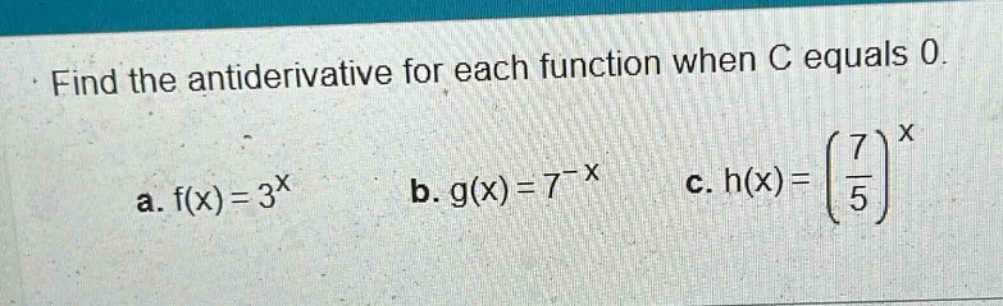
find the antiderivative for each function when c equals 0. a. f(x)=3^x b. g(x)=7^(-x) c. h(x)=(7/5)^x
Answer
Explanation:
Step1: Recall antiderivative formula for $a^x$
The antiderivative of $a^x$ is $\frac{a^x}{\ln a}+C$. When $C = 0$, we have the following.
Step2: Find antiderivative of $f(x)=3^x$
Using the formula, the antiderivative $F(x)=\frac{3^x}{\ln 3}$.
Step3: Find antiderivative of $g(x)=7^{-x}$
Rewrite $g(x)$ as $(\frac{1}{7})^x$. Then its antiderivative $G(x)=\frac{(\frac{1}{7})^x}{\ln(\frac{1}{7})}=-\frac{7^{-x}}{\ln 7}$.
Step4: Find antiderivative of $h(x)=(\frac{7}{5})^x$
Using the formula, the antiderivative $H(x)=\frac{(\frac{7}{5})^x}{\ln(\frac{7}{5})}$.
Answer:
a. $\frac{3^x}{\ln 3}$ b. $-\frac{7^{-x}}{\ln 7}$ c. $\frac{(\frac{7}{5})^x}{\ln(\frac{7}{5})}$