find the antiderivative for each function when c equals 0. check your answers by differentiation. (a)…
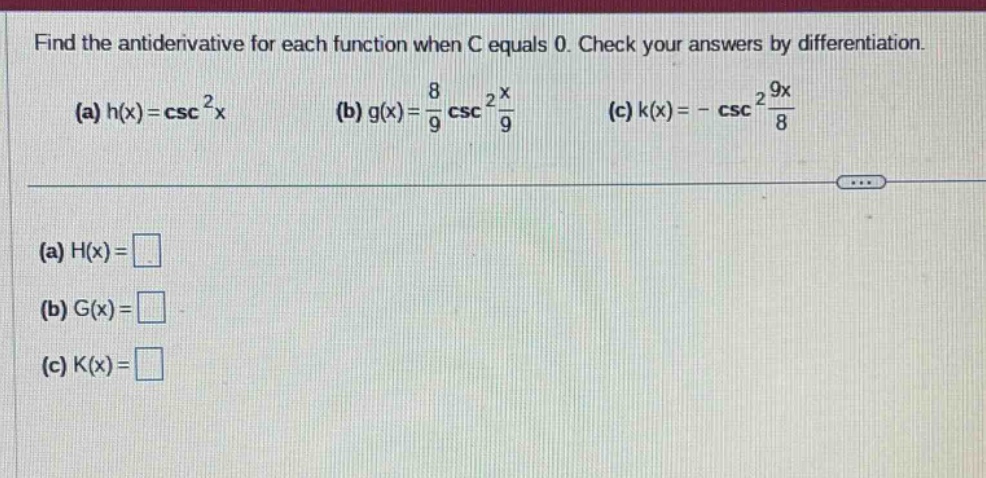
find the antiderivative for each function when c equals 0. check your answers by differentiation. (a) h(x)=csc²x (b) g(x)=8/9 csc²x/9 (c) k(x)= - csc²9x/8 (a) h(x)= (b) g(x)= (c) k(x)=
Answer
Explanation:
Step1: Recall antiderivative of $\csc^{2}u$
The antiderivative of $\csc^{2}u$ with respect to $u$ is $-\cot u + C$. When $C = 0$, for $u=x$ in part (a).
Step2: Find $H(x)$
For $h(x)=\csc^{2}x$, using the above - mentioned rule, $H(x)=-\cot x$.
Step3: For $g(x)=\frac{8}{9}\csc^{2}\frac{x}{9}$
Let $u = \frac{x}{9}$, then $du=\frac{1}{9}dx$. So, $\int\frac{8}{9}\csc^{2}\frac{x}{9}dx=8\int\csc^{2}\frac{x}{9}\cdot\frac{1}{9}dx$. Substituting $u$ and $du$, we get $8\int\csc^{2}u du$.
Step4: Calculate $G(x)$
Since $\int\csc^{2}u du=-\cot u + C$ and $C = 0$, $G(x)=- 8\cot\frac{x}{9}$.
Step5: For $k(x)=-\csc^{2}\frac{9x}{8}$
Let $u=\frac{9x}{8}$, then $du=\frac{9}{8}dx$. So, $\int-\csc^{2}\frac{9x}{8}dx=-\frac{8}{9}\int\csc^{2}\frac{9x}{8}\cdot\frac{9}{8}dx$.
Step6: Calculate $K(x)$
Substituting $u$ and $du$ and using $\int\csc^{2}u du=-\cot u + C$ with $C = 0$, we have $K(x)=\frac{8}{9}\cot\frac{9x}{8}$.
Answer:
(a) $-\cot x$ (b) $-8\cot\frac{x}{9}$ (c) $\frac{8}{9}\cot\frac{9x}{8}$