find the antiderivative for each function when c equals 0. do as many as you can mentally. check your…
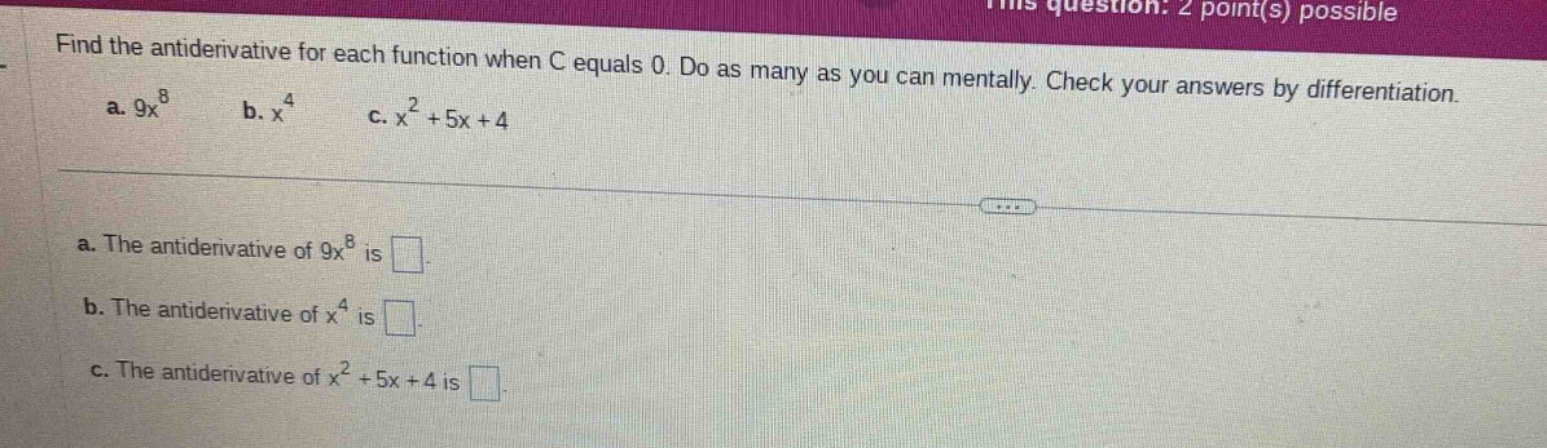
find the antiderivative for each function when c equals 0. do as many as you can mentally. check your answers by differentiation. a. 9x^8 b. x^4 c. x^2 + 5x + 4 a. the antiderivative of 9x^8 is . b. the antiderivative of x^4 is . c. the antiderivative of x^2 + 5x + 4 is
Answer
Explanation:
Step1: Recall power - rule for antiderivatives
The antiderivative of $x^n$ is $\frac{x^{n + 1}}{n+1}+C$ ($n\neq - 1$).
Step2: Find antiderivative of $9x^8$
For $y = 9x^8$, using the power - rule, we have $\int9x^8dx=9\times\frac{x^{8 + 1}}{8+1}=x^{9}$.
Step3: Find antiderivative of $x^4$
For $y = x^4$, by the power - rule, $\int x^4dx=\frac{x^{4+1}}{4 + 1}=\frac{1}{5}x^{5}$.
Step4: Find antiderivative of $x^2+5x + 4$
Using the sum - rule of integration $\int(f(x)+g(x)+h(x))dx=\int f(x)dx+\int g(x)dx+\int h(x)dx$. $\int(x^2+5x + 4)dx=\int x^2dx+5\int xdx+\int4dx$. Applying the power - rule: $\int x^2dx=\frac{x^{3}}{3}$, $5\int xdx=5\times\frac{x^{2}}{2}=\frac{5}{2}x^{2}$, $\int4dx = 4x$. So $\int(x^2+5x + 4)dx=\frac{1}{3}x^{3}+\frac{5}{2}x^{2}+4x$.
Answer:
a. $x^{9}$ b. $\frac{1}{5}x^{5}$ c. $\frac{1}{3}x^{3}+\frac{5}{2}x^{2}+4x$