find any horizontal or vertical asymptotes. f(x) = (x^2 - 100)/(x + 10) select the correct choice below and…
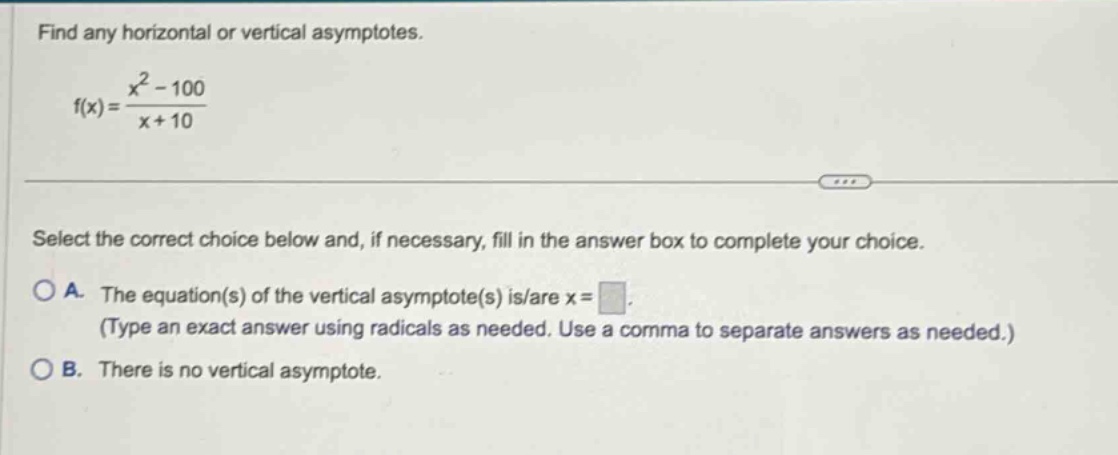
find any horizontal or vertical asymptotes. f(x) = (x^2 - 100)/(x + 10) select the correct choice below and, if necessary, fill in the answer box to complete your choice. a. the equation(s) of the vertical asymptote(s) is/are x = (type an exact answer using radicals as needed. use a comma to separate answers as needed.) b. there is no vertical asymptote.
Answer
Explanation:
Step1: Simplify the function
First, factor the numerator $x^{2}-100=(x + 10)(x - 10)$. So $f(x)=\frac{(x + 10)(x - 10)}{x + 10}=x - 10,x\neq - 10$.
Step2: Find vertical asymptotes
A vertical asymptote occurs where the denominator of a rational - function is zero and the numerator is non - zero. After simplification, the original function is equivalent to a linear function with a hole at $x=-10$ rather than a vertical asymptote. Since the simplified function $y=x - 10$ has no values that make the denominator zero while the numerator is non - zero, there is no vertical asymptote.
Answer:
B. There is no vertical asymptote.