find any relative extrema of the function. list each extremum along with the x - value at which it occurs…
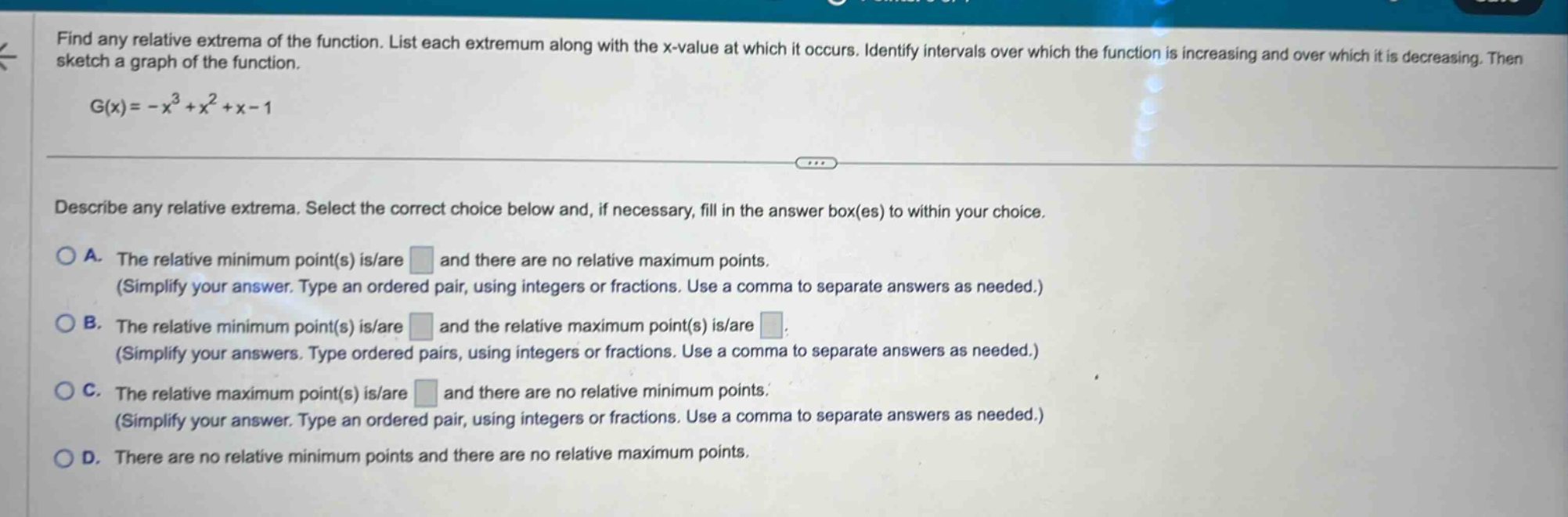
find any relative extrema of the function. list each extremum along with the x - value at which it occurs. identify intervals over which the function is increasing and over which it is decreasing. then sketch a graph of the function. g(x)=-x³ + x² + x - 1 describe any relative extrema. select the correct choice below and, if necessary, fill in the answer box(es) to within your choice. a. the relative minimum point(s) is/are and there are no relative maximum points. (simplify your answer. type an ordered pair, using integers or fractions. use a comma to separate answers as needed.) b. the relative minimum point(s) is/are and the relative maximum point(s) is/are (simplify your answers. type ordered pairs, using integers or fractions. use a comma to separate answers as needed.) c. the relative maximum point(s) is/are and there are no relative minimum points. (simplify your answer. type an ordered pair, using integers or fractions. use a comma to separate answers as needed.) d. there are no relative minimum points and there are no relative maximum points.
Answer
Explanation:
Step1: Find the derivative
Differentiate $G(x)=-x^{3}+x^{2}+x - 1$ using the power - rule. $G'(x)=-3x^{2}+2x + 1$.
Step2: Set the derivative equal to zero
Solve $-3x^{2}+2x + 1 = 0$. Factor the quadratic equation: $-3x^{2}+3x - x+1 = 0$, $-3x(x - 1)-(x - 1)=0$, $(-3x - 1)(x - 1)=0$. So $x=-\frac{1}{3}$ or $x = 1$.
Step3: Use the second - derivative test
Differentiate $G'(x)$ to get the second - derivative $G''(x)=-6x + 2$. When $x=-\frac{1}{3}$, $G''(-\frac{1}{3})=-6\times(-\frac{1}{3})+2=4>0$. So $G(x)$ has a relative minimum at $x = -\frac{1}{3}$. $G(-\frac{1}{3})=-(-\frac{1}{3})^{3}+(-\frac{1}{3})^{2}+(-\frac{1}{3})-1=-\frac{32}{27}$. When $x = 1$, $G''(1)=-6\times1+2=-4<0$. So $G(x)$ has a relative maximum at $x = 1$. $G(1)=-1 + 1+1 - 1=0$.
Step4: Determine increasing and decreasing intervals
Test intervals using the first - derivative. The intervals are $(-\infty,-\frac{1}{3})$, $(-\frac{1}{3},1)$ and $(1,\infty)$. For $x<- \frac{1}{3}$, let $x=-1$, $G'(-1)=-3-2 + 1=-4<0$, so $G(x)$ is decreasing on $(-\infty,-\frac{1}{3})$. For $-\frac{1}{3}<x<1$, let $x = 0$, $G'(0)=1>0$, so $G(x)$ is increasing on $(-\frac{1}{3},1)$. For $x>1$, let $x = 2$, $G'(2)=-3\times4 + 2\times2+1=-7<0$, so $G(x)$ is decreasing on $(1,\infty)$.
Answer:
B. The relative minimum point(s) is/are $(-\frac{1}{3},-\frac{32}{27})$ and the relative maximum point(s) is/are $(1,0)$