find any relative extrema of the function. list each extremum along with the x - value at which it occurs…
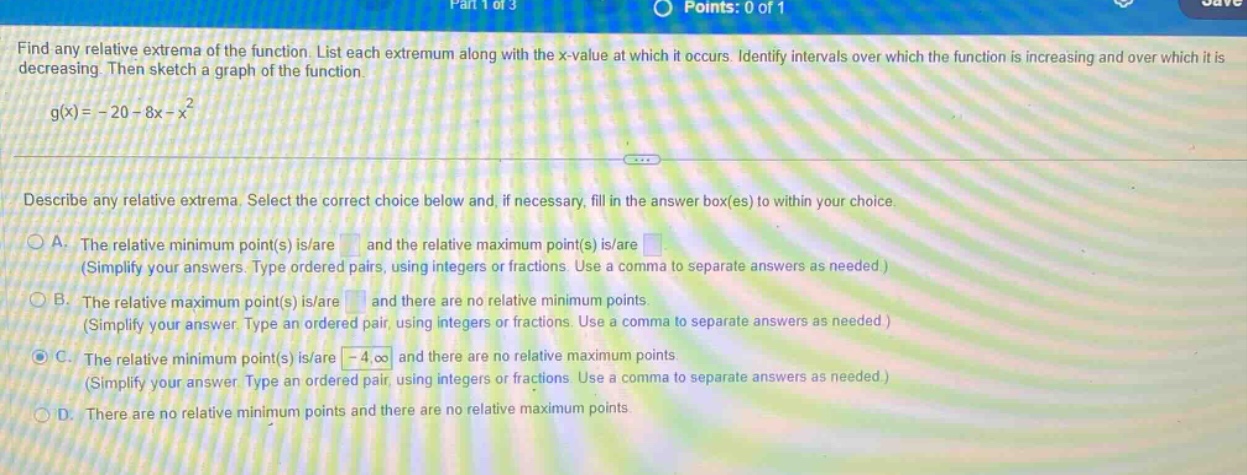
find any relative extrema of the function. list each extremum along with the x - value at which it occurs. identify intervals over which the function is increasing and over which it is decreasing. then sketch a graph of the function. g(x)= - 20 - 8x - x² describe any relative extrema. select the correct choice below and, if necessary, fill in the answer box(es) to within your choice. a. the relative minimum point(s) is/are and the relative maximum point(s) is/are (simplify your answers. type ordered pairs, using integers or fractions. use a comma to separate answers as needed ) b. the relative maximum point(s) is/are and there are no relative minimum points. (simplify your answer. type an ordered pair, using integers or fractions. use a comma to separate answers as needed ) c. the relative minimum point(s) is/are - 4,∞ and there are no relative maximum points. (simplify your answer. type an ordered pair, using integers or fractions. use a comma to separate answers as needed ) d. there are no relative minimum points and there are no relative maximum points.
Answer
Explanation:
Step1: Find the derivative
The function is $g(x)=-20 - 8x - x^{2}$. Using the power - rule $(x^n)'=nx^{n - 1}$, the derivative $g'(x)=-8 - 2x$.
Step2: Find critical points
Set $g'(x) = 0$. So, $-8 - 2x=0$. Solving for $x$ gives $-2x=8$, then $x=-4$.
Step3: Determine the nature of the critical point
Take the second - derivative $g''(x)=-2$. Since $g''(-4)=-2<0$, the function has a relative maximum at $x = - 4$. Substitute $x=-4$ into the original function $g(-4)=-20-8\times(-4)-(-4)^{2}=-20 + 32-16=-4$. So the relative maximum point is $(-4,-4)$.
Step4: Find intervals of increase and decrease
Choose a test point in the interval $x<-4$, say $x=-5$. Then $g'(-5)=-8-2\times(-5)=-8 + 10 = 2>0$, so the function is increasing on the interval $(-\infty,-4)$. Choose a test point in the interval $x>-4$, say $x=-3$. Then $g'(-3)=-8-2\times(-3)=-8 + 6=-2<0$, so the function is decreasing on the interval $(-4,\infty)$.
Answer:
B. The relative maximum point(s) is/are $(-4,-4)$ and there are no relative minimum points.