find the area of the region bounded by the graphs of the given equations. y = x², y = -2 - 2x, x = 0, x = 1
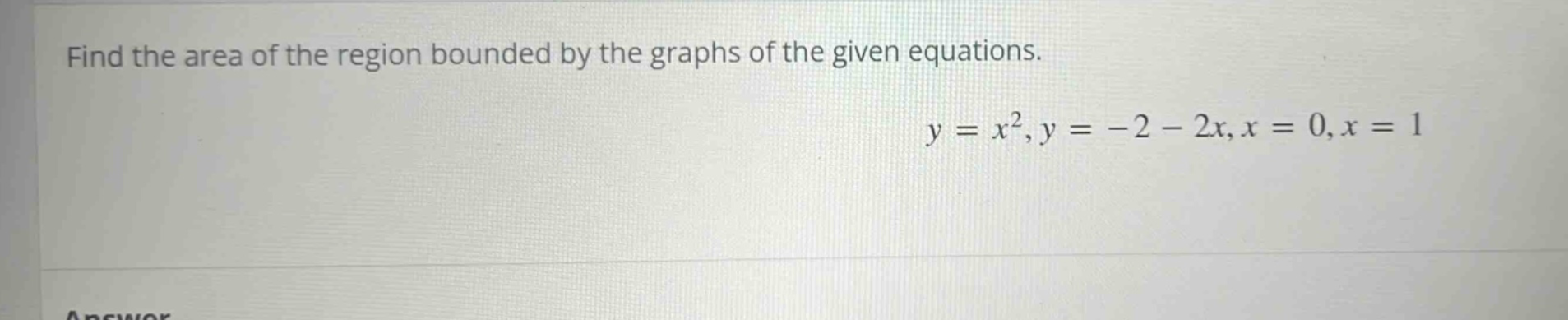
find the area of the region bounded by the graphs of the given equations. y = x², y = -2 - 2x, x = 0, x = 1
Answer
Explanation:
Step1: Determine the upper - lower functions
On the interval $[0,1]$, we need to find which function is above the other. Let's compare $y = x^{2}$ and $y=-2 - 2x$. For $x\in[0,1]$, $x^{2}\geq - 2-2x$. We can check by taking the difference $f(x)=x^{2}+2 + 2x=(x + 1)^{2}+1>0$ for $x\in[0,1]$. The formula for the area $A$ between two curves $y = f(x)$ and $y = g(x)$ from $x=a$ to $x = b$ is $A=\int_{a}^{b}[f(x)-g(x)]dx$. Here, $f(x)=x^{2}$, $g(x)=-2 - 2x$, $a = 0$, $b = 1$.
Step2: Set up the integral
The area $A$ is given by the integral $A=\int_{0}^{1}[x^{2}-(-2 - 2x)]dx=\int_{0}^{1}(x^{2}+2 + 2x)dx$.
Step3: Integrate term - by - term
We know that $\int x^{n}dx=\frac{x^{n + 1}}{n+1}+C$ ($n\neq - 1$), $\int kdx=kx + C$ ($k$ is a constant). $\int_{0}^{1}(x^{2}+2 + 2x)dx=\left[\frac{x^{3}}{3}+2x+x^{2}\right]_{0}^{1}$.
Step4: Evaluate the definite integral
Substitute the upper and lower limits: $\left(\frac{1^{3}}{3}+2\times1 + 1^{2}\right)-\left(\frac{0^{3}}{3}+2\times0+0^{2}\right)=\frac{1}{3}+2 + 1$. $=\frac{1 + 6+3}{3}=\frac{10}{3}$.
Answer:
$\frac{10}{3}$