find the area of the region enclosed by the graphs of y = 2 sin(x) and y = 4 cos(x) from x = 0 to x = 3π/4.
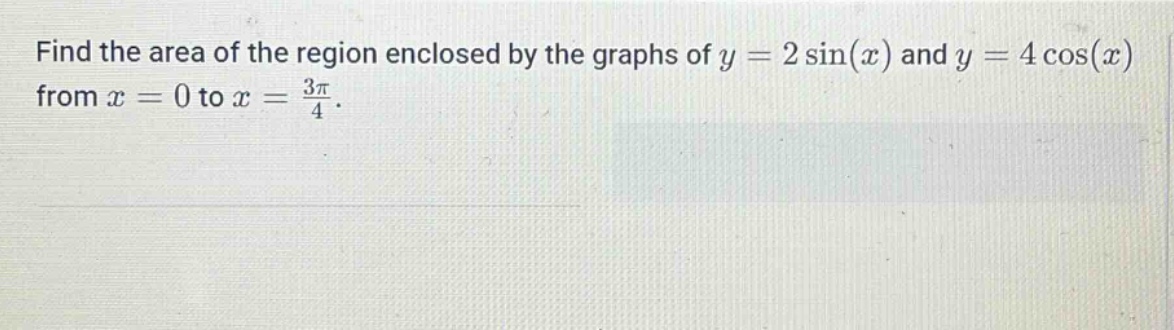
find the area of the region enclosed by the graphs of y = 2 sin(x) and y = 4 cos(x) from x = 0 to x = 3π/4.
Answer
Explanation:
Step1: Determine the upper - lower function
We need to find where $2\sin(x)\geq4\cos(x)$ and $2\sin(x)<4\cos(x)$ on the interval $[0,\frac{3\pi}{4}]$. Set $2\sin(x)=4\cos(x)$, then $\tan(x) = 2$, and $x=\arctan(2)$. On $[0,\arctan(2)]$, $4\cos(x)\geq2\sin(x)$; on $[\arctan(2),\frac{3\pi}{4}]$, $2\sin(x)\geq4\cos(x)$.
Step2: Set up the integral for the area
The area $A$ between two curves $y = f(x)$ and $y = g(x)$ from $x=a$ to $x = b$ is given by $A=\int_{a}^{b}|f(x)-g(x)|dx$. So $A=\int_{0}^{\arctan(2)}(4\cos(x)-2\sin(x))dx+\int_{\arctan(2)}^{\frac{3\pi}{4}}(2\sin(x)-4\cos(x))dx$.
Step3: Integrate term - by - term
The antiderivative of $\cos(x)$ is $\sin(x)$ and the antiderivative of $\sin(x)$ is $-\cos(x)$. For $\int_{0}^{\arctan(2)}(4\cos(x)-2\sin(x))dx=[4\sin(x)+2\cos(x)]{0}^{\arctan(2)}$. If $x = \arctan(2)$, let $\theta=\arctan(2)$, then $\tan\theta=2=\frac{\sin\theta}{\cos\theta}$ and $\sin\theta=\frac{2}{\sqrt{5}}$, $\cos\theta=\frac{1}{\sqrt{5}}$. $[4\sin(x)+2\cos(x)]{0}^{\arctan(2)}=(4\times\frac{2}{\sqrt{5}}+2\times\frac{1}{\sqrt{5}})-(4\times0 + 2\times1)=\frac{8 + 2}{\sqrt{5}}-2=\frac{10}{\sqrt{5}}-2 = 2\sqrt{5}-2$. For $\int_{\arctan(2)}^{\frac{3\pi}{4}}(2\sin(x)-4\cos(x))dx=[-2\cos(x)-4\sin(x)]{\arctan(2)}^{\frac{3\pi}{4}}$. When $x=\frac{3\pi}{4}$, $-2\cos(\frac{3\pi}{4})-4\sin(\frac{3\pi}{4})=-2\times(-\frac{\sqrt{2}}{2})-4\times\frac{\sqrt{2}}{2}=\sqrt{2}-2\sqrt{2}=-\sqrt{2}$. When $x = \arctan(2)$, $-2\cos(x)-4\sin(x)=-2\times\frac{1}{\sqrt{5}}-4\times\frac{2}{\sqrt{5}}=-\frac{2 + 8}{\sqrt{5}}=-\frac{10}{\sqrt{5}}=-2\sqrt{5}$. $[-2\cos(x)-4\sin(x)]{\arctan(2)}^{\frac{3\pi}{4}}=-\sqrt{2}-(-2\sqrt{5})=2\sqrt{5}-\sqrt{2}$.
Step4: Calculate the total area
$A=(2\sqrt{5}-2)+(2\sqrt{5}-\sqrt{2})=4\sqrt{5}-2-\sqrt{2}$.
Answer:
$4\sqrt{5}-2 - \sqrt{2}$