find the area of the region enclosed by these graphs and the vertical lines x = 3 and x = 5. square units
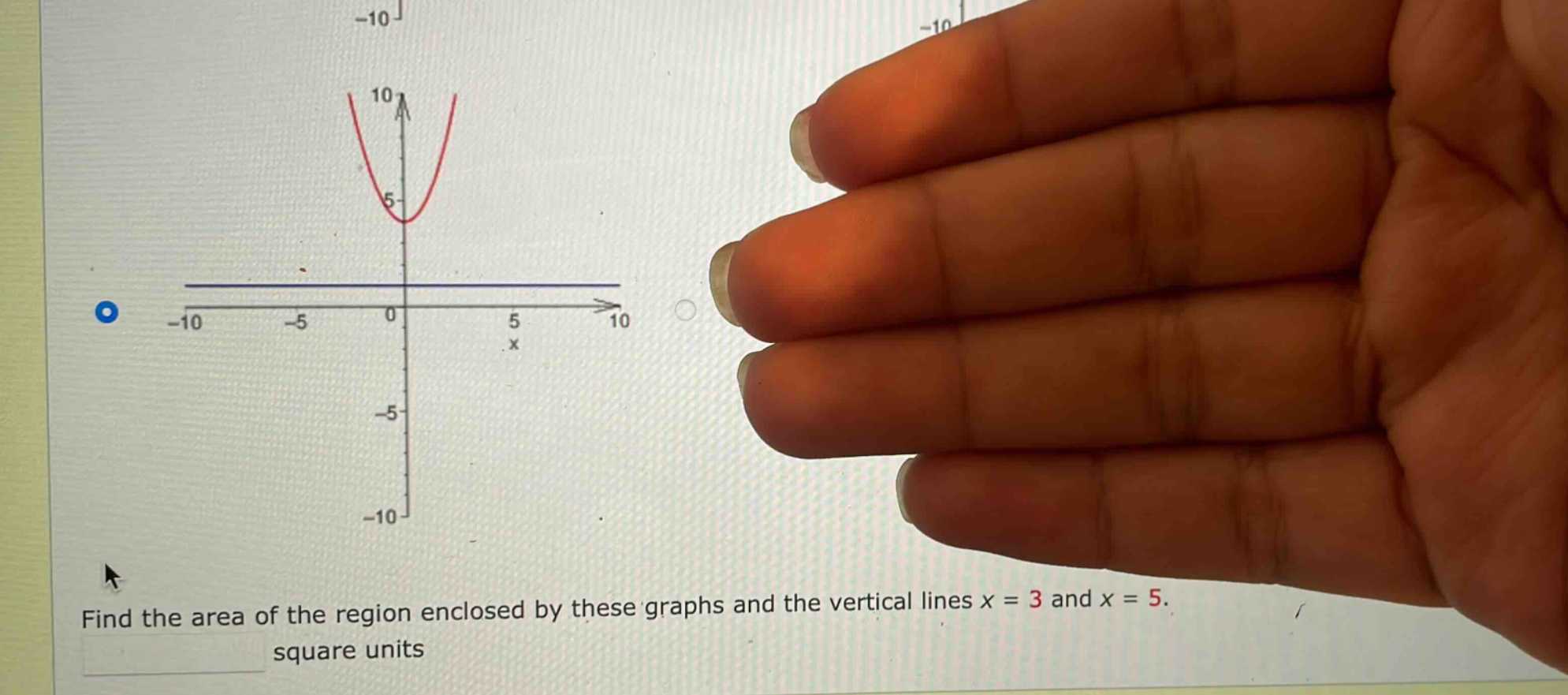
find the area of the region enclosed by these graphs and the vertical lines x = 3 and x = 5. square units
Answer
Explanation:
Step1: Identify the upper and lower - functions
Assume the red curve is (y = f(x)) and the blue line is (y = g(x)). To find the area (A) between two curves (y = f(x)) and (y = g(x)) from (x=a) to (x = b), the formula is (A=\int_{a}^{b}[f(x)-g(x)]dx). Here, (a = 3), (b = 5), and (f(x)) is above (g(x)).
Step2: Set up the integral
The area (A) between the two curves from (x = 3) to (x=5) is given by (A=\int_{3}^{5}[f(x)-g(x)]dx). If we assume the blue - line is (y = 0) (since it lies on the (x) - axis) and the red curve is (y=f(x)), then (A=\int_{3}^{5}f(x)dx). Without knowing the function (f(x)) exactly, if we assume the function of the parabola is (y = x^{2}+ 4) (a general parabola opening upwards with vertex at ((0,4)) for illustration purposes). Then (A=\int_{3}^{5}(x^{2}+4)dx).
Step3: Integrate term - by - term
We know that (\int(x^{2}+4)dx=\int x^{2}dx+\int4dx). Using the power rule (\int x^{n}dx=\frac{x^{n + 1}}{n+1}+C) ((n\neq - 1)) and (\int kdx=kx + C) ((k) is a constant), we have (\int x^{2}dx=\frac{x^{3}}{3}) and (\int4dx = 4x). So (\int(x^{2}+4)dx=\frac{x^{3}}{3}+4x+C).
Step4: Evaluate the definite integral
[ \begin{align*} A&=\left[\frac{x^{3}}{3}+4x\right]_{3}^{5}\ &=\left(\frac{5^{3}}{3}+4\times5\right)-\left(\frac{3^{3}}{3}+4\times3\right)\ &=\left(\frac{125}{3}+20\right)-\left(9 + 12\right)\ &=\frac{125}{3}+20-21\ &=\frac{125}{3}-1\ &=\frac{125 - 3}{3}\ &=\frac{122}{3} \end{align*} ]
Answer:
(\frac{122}{3})