find the area of the region that lies inside the first curve and outside the second curve. r = 4 - 4sin(θ)…
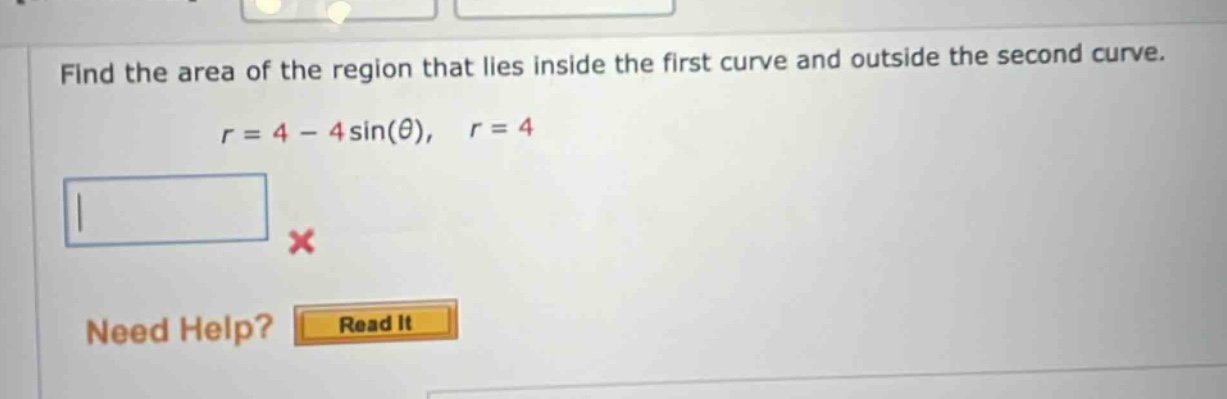
find the area of the region that lies inside the first curve and outside the second curve. r = 4 - 4sin(θ), r = 4
Answer
Explanation:
Step1: Find intersection points
Set $4 - 4\sin(\theta)=4$, then $- 4\sin(\theta)=0$, so $\sin(\theta)=0$. The solutions in the range $[0,2\pi]$ are $\theta = 0$ and $\theta=\pi$.
Step2: Use the area - formula for polar curves
The area formula for a polar - curve is $A=\frac{1}{2}\int_{\alpha}^{\beta}(r_1^{2}-r_2^{2})d\theta$. Here, $r_1 = 4 - 4\sin(\theta)$ and $r_2 = 4$, and $\alpha = 0$, $\beta=\pi$. So $A=\frac{1}{2}\int_{0}^{\pi}((4 - 4\sin(\theta))^{2}-4^{2})d\theta$.
Step3: Expand the integrand
Expand $(4 - 4\sin(\theta))^{2}-4^{2}$: [ \begin{align*} (4 - 4\sin(\theta))^{2}-4^{2}&=(16 - 32\sin(\theta)+16\sin^{2}(\theta))-16\ &=-32\sin(\theta)+16\sin^{2}(\theta) \end{align*} ] Since $\sin^{2}(\theta)=\frac{1 - \cos(2\theta)}{2}$, the integrand becomes $-32\sin(\theta)+16\times\frac{1 - \cos(2\theta)}{2}=-32\sin(\theta)+8 - 8\cos(2\theta)$.
Step4: Integrate term - by - term
(\int(-32\sin(\theta)+8 - 8\cos(2\theta))d\theta=32\cos(\theta)+8\theta-4\sin(2\theta)+C).
Step5: Evaluate the definite integral
[ \begin{align*} A&=\frac{1}{2}\left[32\cos(\theta)+8\theta-4\sin(2\theta)\right]_{0}^{\pi}\ &=\frac{1}{2}((32\cos(\pi)+8\pi-4\sin(2\pi))-(32\cos(0)+8\times0 - 4\sin(0)))\ &=\frac{1}{2}((-32 + 8\pi-0)-(32+0 - 0))\ &=\frac{1}{2}(-32 + 8\pi-32)\ &=4\pi - 32 \end{align*} ] Since area cannot be negative, we take the absolute value. The area (A = 32 - 4\pi).
Answer:
$32 - 4\pi$