find the area of the shaded region.\nf(x)=20x + x^2 - x^3, g(x)=0
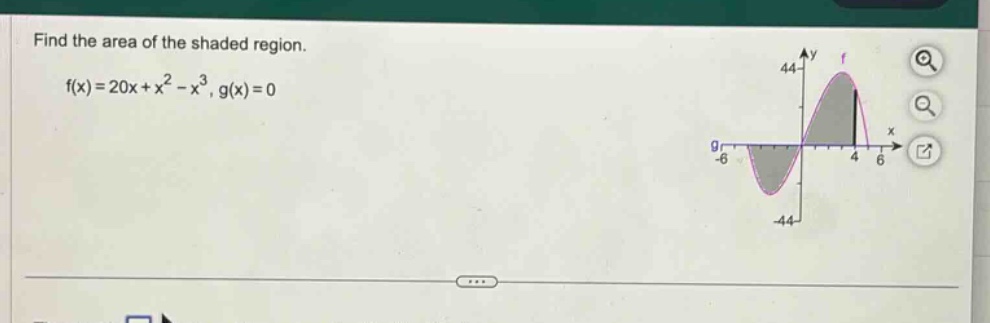
find the area of the shaded region.\nf(x)=20x + x^2 - x^3, g(x)=0
Answer
Explanation:
Step1: Find intersection points
Set $f(x)=g(x)$, so $20x + x^{2}-x^{3}=0$. Factor out $x$: $x(20 + x - x^{2})=0$, then $x(5 - x)(4+x)=0$. The roots are $x=- 4,0,5$.
Step2: Set up integral for area
The area $A=\int_{-4}^{5}|20x + x^{2}-x^{3}|dx$. Since $y = 20x + x^{2}-x^{3}$ is non - positive on $[-4,0]$ and non - negative on $[0,5]$, we have $A=-\int_{-4}^{0}(20x + x^{2}-x^{3})dx+\int_{0}^{5}(20x + x^{2}-x^{3})dx$.
Step3: Integrate term - by - term
The antiderivative of $20x + x^{2}-x^{3}$ is $F(x)=10x^{2}+\frac{1}{3}x^{3}-\frac{1}{4}x^{4}+C$. $-\left[10x^{2}+\frac{1}{3}x^{3}-\frac{1}{4}x^{4}\right]{-4}^{0}+\left[10x^{2}+\frac{1}{3}x^{3}-\frac{1}{4}x^{4}\right]{0}^{5}$ $=-\left(0-(10\times(-4)^{2}+\frac{1}{3}\times(-4)^{3}-\frac{1}{4}\times(-4)^{4})\right)+\left(10\times5^{2}+\frac{1}{3}\times5^{3}-\frac{1}{4}\times5^{4}-0\right)$ $=-(0-(160-\frac{64}{3}-64))+(250+\frac{125}{3}-\frac{625}{4})$ $=(160-\frac{64}{3}-64)+(250+\frac{125}{3}-\frac{625}{4})$ $=(96-\frac{64}{3})+(250+\frac{125}{3}-\frac{625}{4})$ $=96-\frac{64}{3}+250+\frac{125}{3}-\frac{625}{4}$ $=(96 + 250)+(\frac{-64 + 125}{3})-\frac{625}{4}$ $=346+\frac{61}{3}-\frac{625}{4}$ $=\frac{4152 + 244-1875}{12}=\frac{4396 - 1875}{12}=\frac{2521}{12}\approx210.083$.
Answer:
$\frac{2521}{12}$