find the area of the surface generated when the given curve is revolved about the x - axis.\ny =…
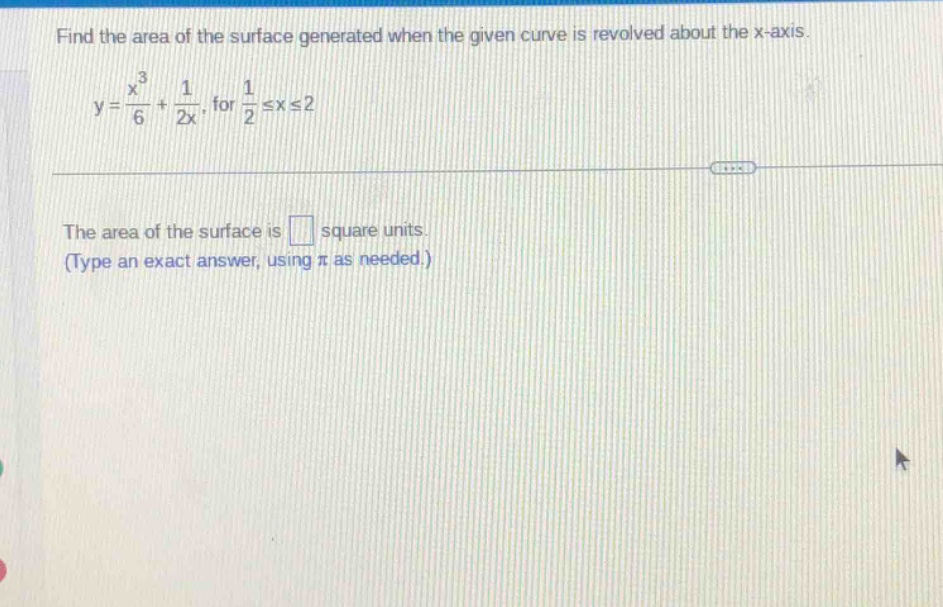
find the area of the surface generated when the given curve is revolved about the x - axis.\ny = \\frac{x^{3}}{6}+\\frac{1}{2x}, for \\frac{1}{2}\\leq x\\leq2\n\nthe area of the surface is square units.\n(type an exact answer, using \\pi as needed.)
Answer
Explanation:
Step1: Find the derivative of $y$
First, find $y'$ where $y=\frac{x^{3}}{6}+\frac{1}{2x}=\frac{x^{3}}{6}+\frac{1}{2}x^{- 1}$. Using the power - rule $(x^n)'=nx^{n - 1}$, we have $y'=\frac{3x^{2}}{6}-\frac{1}{2}x^{-2}=\frac{x^{2}}{2}-\frac{1}{2x^{2}}$.
Step2: Calculate $1+(y')^{2}$
[ \begin{align*} 1+(y')^{2}&=1 + (\frac{x^{2}}{2}-\frac{1}{2x^{2}})^{2}\ &=1+\frac{x^{4}}{4}- \frac{1}{2}+\frac{1}{4x^{4}}\ &=\frac{x^{4}}{4}+\frac{1}{2}+\frac{1}{4x^{4}}\ &=(\frac{x^{2}}{2}+\frac{1}{2x^{2}})^{2} \end{align*} ]
Step3: Use the surface - area formula
The formula for the surface area $S$ of the surface generated by revolving the curve $y = f(x)$ about the $x$ - axis from $a$ to $b$ is $S = 2\pi\int_{a}^{b}y\sqrt{1+(y')^{2}}dx$. Here, $a=\frac{1}{2}$, $b = 2$, $y=\frac{x^{3}}{6}+\frac{1}{2x}$, and $\sqrt{1+(y')^{2}}=\frac{x^{2}}{2}+\frac{1}{2x^{2}}$. So, $S=2\pi\int_{\frac{1}{2}}^{2}(\frac{x^{3}}{6}+\frac{1}{2x})(\frac{x^{2}}{2}+\frac{1}{2x^{2}})dx$. Expand the integrand: [ \begin{align*} (\frac{x^{3}}{6}+\frac{1}{2x})(\frac{x^{2}}{2}+\frac{1}{2x^{2}})&=\frac{x^{3}}{6}\cdot\frac{x^{2}}{2}+\frac{x^{3}}{6}\cdot\frac{1}{2x^{2}}+\frac{1}{2x}\cdot\frac{x^{2}}{2}+\frac{1}{2x}\cdot\frac{1}{2x^{2}}\ &=\frac{x^{5}}{12}+\frac{x}{12}+\frac{x}{4}+\frac{1}{4x^{3}}\ &=\frac{x^{5}}{12}+\frac{x}{3}+\frac{1}{4x^{3}} \end{align*} ]
Step4: Integrate the expanded integrand
[ \begin{align*} S&=2\pi\int_{\frac{1}{2}}^{2}(\frac{x^{5}}{12}+\frac{x}{3}+\frac{1}{4x^{3}})dx\ &=2\pi\left[\frac{x^{6}}{72}+\frac{x^{2}}{6}-\frac{1}{8x^{2}}\right]_{\frac{1}{2}}^{2}\ &=2\pi\left[\left(\frac{2^{6}}{72}+\frac{2^{2}}{6}-\frac{1}{8\times2^{2}}\right)-\left(\frac{(\frac{1}{2})^{6}}{72}+\frac{(\frac{1}{2})^{2}}{6}-\frac{1}{8\times(\frac{1}{2})^{2}}\right)\right]\ &=2\pi\left[\left(\frac{64}{72}+\frac{4}{6}-\frac{1}{32}\right)-\left(\frac{1}{4608}+\frac{1}{24}-\frac{1}{2}\right)\right]\ &=2\pi\left[\left(\frac{8}{9}+\frac{2}{3}-\frac{1}{32}\right)-\left(\frac{1 + 192-2304}{4608}\right)\right]\ &=2\pi\left[\left(\frac{8\times32 + 2\times96-9}{288}\right)-\left(-\frac{2111}{4608}\right)\right]\ &=2\pi\left[\frac{256+192 - 9}{288}+\frac{2111}{4608}\right]\ &=2\pi\left[\frac{439}{288}+\frac{2111}{4608}\right]\ &=2\pi\left[\frac{439\times16+2111}{4608}\right]\ &=2\pi\left[\frac{7024 + 2111}{4608}\right]\ &=2\pi\times\frac{9135}{4608}\ &=\frac{1985\pi}{512} \end{align*} ]
Answer:
$\frac{1985\pi}{512}$