find the area of the surface generated by revolving x = √(14y - y²) on the interval 3 ≤ y ≤ 10 about the y…
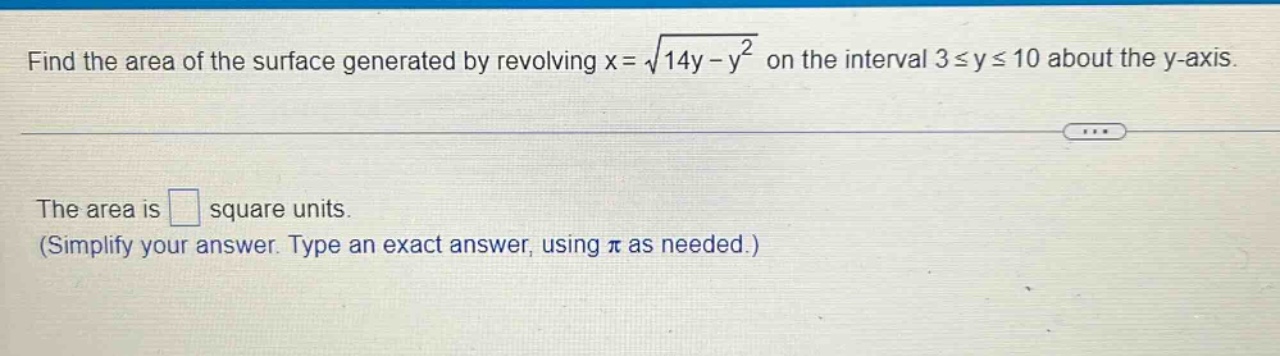
find the area of the surface generated by revolving x = √(14y - y²) on the interval 3 ≤ y ≤ 10 about the y - axis. the area is square units. (simplify your answer. type an exact answer, using π as needed.)
Answer
Explanation:
Step1: Recall surface - area formula
The formula for the surface area (S) of a surface generated by revolving (x = g(y)) about the (y) - axis on the interval ([a,b]) is (S=2\pi\int_{a}^{b}x\sqrt{1+(x')^{2}}dy). First, find the derivative of (x = \sqrt{14y - y^{2}}). Using the chain - rule, if (u = 14y - y^{2}), then (x=\sqrt{u}) and (\frac{dx}{du}=\frac{1}{2\sqrt{u}}), (\frac{du}{dy}=14 - 2y). So (x'=\frac{14 - 2y}{2\sqrt{14y - y^{2}}}=\frac{7 - y}{\sqrt{14y - y^{2}}}).
Step2: Calculate (1+(x')^{2})
[ \begin{align*} 1+(x')^{2}&=1+\frac{(7 - y)^{2}}{14y - y^{2}}\ &=\frac{14y - y^{2}+49 - 14y + y^{2}}{14y - y^{2}}\ &=\frac{49}{14y - y^{2}} \end{align*} ] Then (\sqrt{1+(x')^{2}}=\frac{7}{\sqrt{14y - y^{2}}}).
Step3: Set up the integral for surface area
Substitute (x=\sqrt{14y - y^{2}}) and (\sqrt{1+(x')^{2}}=\frac{7}{\sqrt{14y - y^{2}}}) into the surface - area formula: [ \begin{align*} S&=2\pi\int_{3}^{10}\sqrt{14y - y^{2}}\cdot\frac{7}{\sqrt{14y - y^{2}}}dy\ &=14\pi\int_{3}^{10}dy \end{align*} ]
Step4: Evaluate the integral
[ \begin{align*} 14\pi\int_{3}^{10}dy&=14\pi\left[y\right]_{3}^{10}\ &=14\pi(10 - 3)\ &=98\pi \end{align*} ]
Answer:
(98\pi)