find t_n centered at x = 2 for all n for the function f(x)=e^x. (use symbolic notation and fractions where…
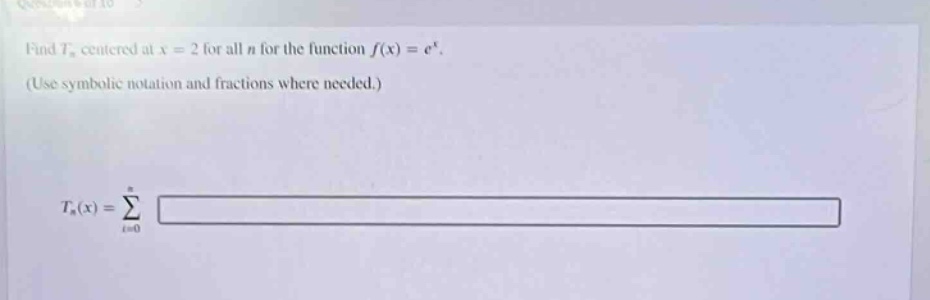
find t_n centered at x = 2 for all n for the function f(x)=e^x. (use symbolic notation and fractions where needed.) t_n(x)=∑_(i = 0)^n
Answer
Explanation:
Step1: Recall Taylor - series formula
The Taylor series of a function $f(x)$ centered at $a$ is given by $T_n(x)=\sum_{k = 0}^{n}\frac{f^{(k)}(a)}{k!}(x - a)^k$, where $f^{(k)}(a)$ is the $k$-th derivative of $f(x)$ evaluated at $x = a$.
Step2: Find the $k$-th derivative of $f(x)=e^x$
The $k$-th derivative of $f(x)=e^x$ is $f^{(k)}(x)=e^x$ for all non - negative integers $k$.
Step3: Evaluate the $k$-th derivative at $a = 2$
Since $f^{(k)}(x)=e^x$, then $f^{(k)}(2)=e^2$ for all non - negative integers $k$.
Step4: Substitute into the Taylor - series formula
Substituting $f^{(k)}(2)=e^2$ and $a = 2$ into the Taylor series formula $T_n(x)=\sum_{k = 0}^{n}\frac{f^{(k)}(a)}{k!}(x - a)^k$, we get $T_n(x)=\sum_{k=0}^{n}\frac{e^{2}}{k!}(x - 2)^k$.
Answer:
$\sum_{k = 0}^{n}\frac{e^{2}}{k!}(x - 2)^k$