find the critical numbers of the function. (enter your answers as a comma - separated list. if an answer…
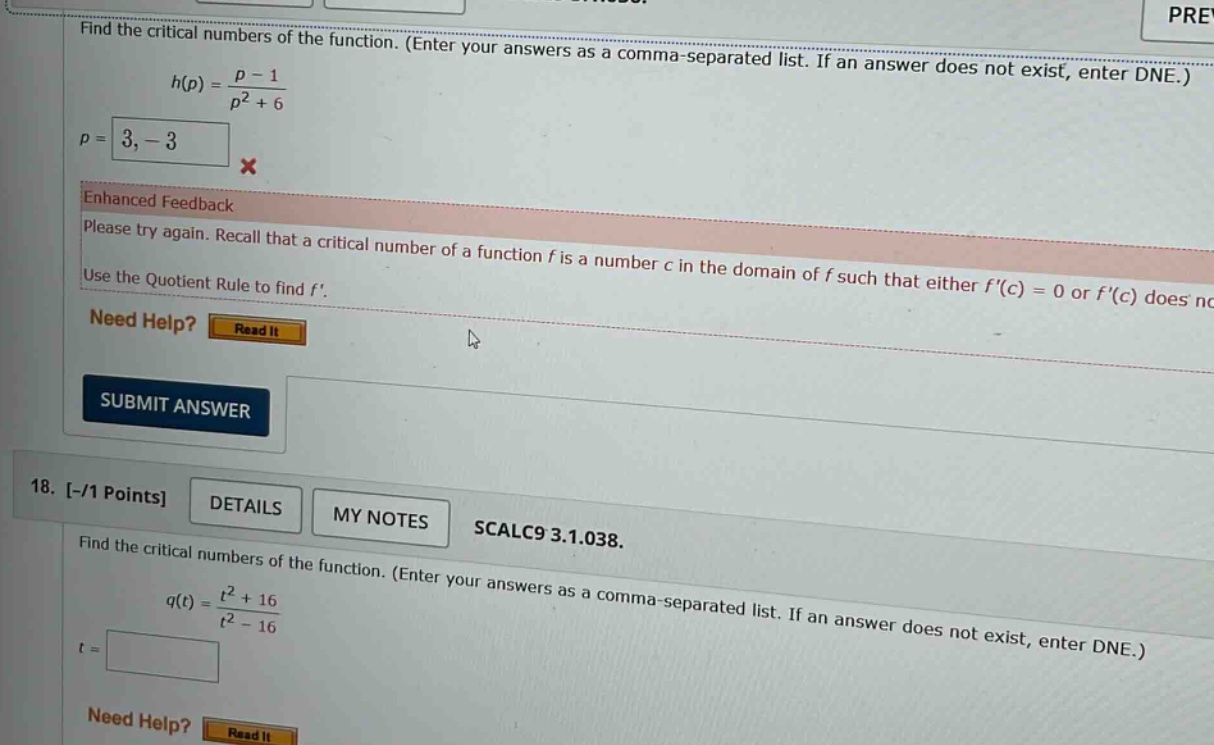
find the critical numbers of the function. (enter your answers as a comma - separated list. if an answer does not exist, enter dne.) h(p) = (p - 1)/(p^2 + 6) p = 3, - 3 x enhanced feedback please try again. recall that a critical number of a function f is a number c in the domain of f such that either f(c) = 0 or f(c) does not exist. use the quotient rule to find f. need help? read it submit answer 18. -/1 points details my notes scalc9 3.1.038. find the critical numbers of the function. (enter your answers as a comma - separated list. if an answer does not exist, enter dne.) q(t) = (t^2 + 16)/(t^2 - 16) t =
Answer
Explanation:
Step1: Recall quotient - rule
The quotient - rule states that if $y=\frac{u}{v}$, then $y'=\frac{u'v - uv'}{v^{2}}$. For $h(p)=\frac{p - 1}{p^{2}+6}$, let $u = p - 1$ and $v=p^{2}+6$. Then $u'=1$ and $v' = 2p$.
Step2: Calculate $h'(p)$
$h'(p)=\frac{1\times(p^{2}+6)-(p - 1)\times2p}{(p^{2}+6)^{2}}=\frac{p^{2}+6-2p^{2}+2p}{(p^{2}+6)^{2}}=\frac{-p^{2}+2p + 6}{(p^{2}+6)^{2}}$.
Step3: Find where $h'(p)=0$
Set the numerator equal to zero: $-p^{2}+2p + 6 = 0$. Multiply through by - 1 to get $p^{2}-2p - 6=0$. Using the quadratic formula $p=\frac{-b\pm\sqrt{b^{2}-4ac}}{2a}$ for the quadratic equation $ax^{2}+bx + c = 0$, here $a = 1$, $b=-2$, $c=-6$. Then $p=\frac{2\pm\sqrt{(-2)^{2}-4\times1\times(-6)}}{2\times1}=\frac{2\pm\sqrt{4 + 24}}{2}=\frac{2\pm\sqrt{28}}{2}=\frac{2\pm2\sqrt{7}}{2}=1\pm\sqrt{7}$.
Step4: Analyze the domain
The denominator $(p^{2}+6)^{2}$ is never zero since $p^{2}+6>0$ for all real $p$. So the critical numbers are $p = 1+\sqrt{7},1 - \sqrt{7}$.
Answer:
$1+\sqrt{7},1 - \sqrt{7}$
For the second function $q(t)=\frac{t^{2}+16}{t^{2}-16}$:
Explanation:
Step1: Apply quotient - rule
Let $u=t^{2}+16$, $u' = 2t$, $v=t^{2}-16$, $v'=2t$. Then $q'(t)=\frac{2t(t^{2}-16)-2t(t^{2}+16)}{(t^{2}-16)^{2}}$.
Step2: Simplify $q'(t)$
$q'(t)=\frac{2t^{3}-32t-2t^{3}-32t}{(t^{2}-16)^{2}}=\frac{-64t}{(t^{2}-16)^{2}}$.
Step3: Find where $q'(t)=0$
Set the numerator equal to zero. Since $-64t = 0$ when $t = 0$.
Step4: Analyze the domain
The denominator $(t^{2}-16)^{2}=(t - 4)^{2}(t + 4)^{2}$ is zero when $t=\pm4$. But we are looking for values in the domain of $q(t)$ where $q'(t)=0$ or $q'(t)$ is undefined. The function $q'(t)$ is undefined at $t=\pm4$, but these are not in the domain of $q(t)$. The critical number is $t = 0$.
Answer:
$0$