a. find the critical points of f on the given interval. b. determine the absolute extreme values of f on the…
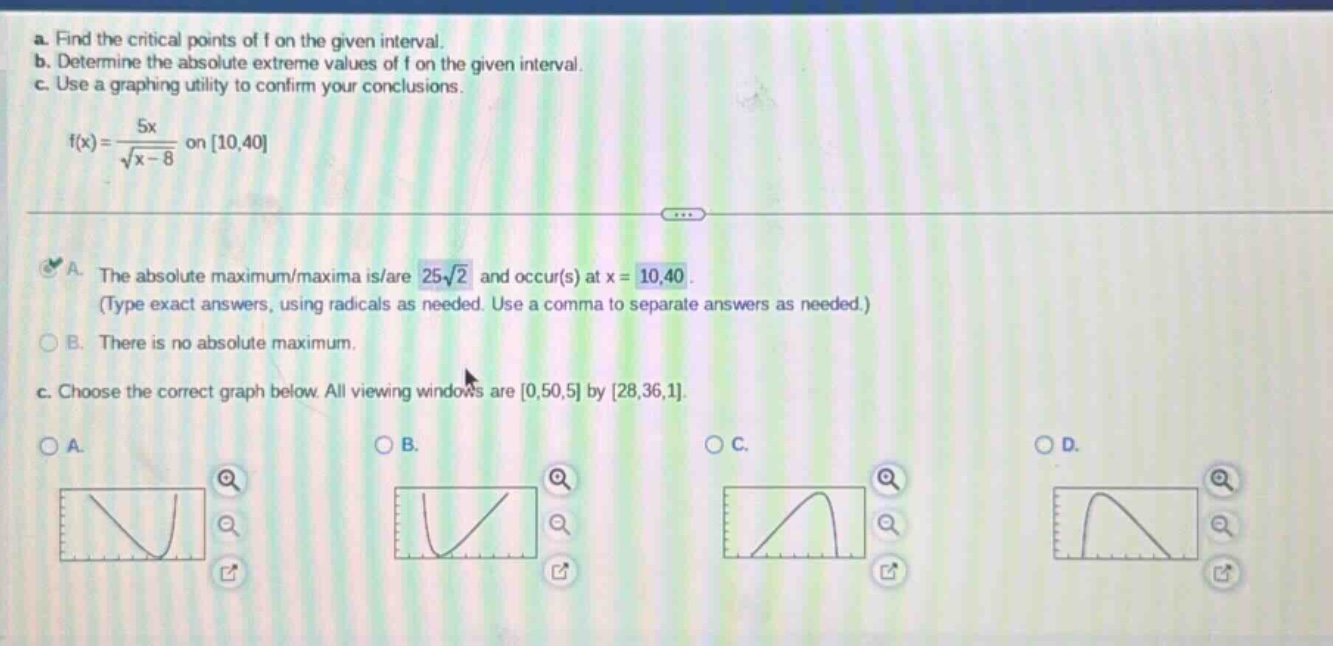
a. find the critical points of f on the given interval. b. determine the absolute extreme values of f on the given interval. c. use a graphing utility to confirm your conclusions. f(x)=5x/√(x - 8) on 10,40 a. the absolute maximum/maxima is/are 25√2 and occur(s) at x = 10,40. (type exact answers, using radicals as needed. use a comma to separate answers as needed.) b. there is no absolute maximum. c. choose the correct graph below. all viewing windows are 0,50,5 by 28,36,1.
Answer
Explanation:
Step1: Find the derivative of (f(x))
Use the quotient - rule ((\frac{u}{v})^\prime=\frac{u^\prime v - uv^\prime}{v^{2}}), where (u = 5x), (u^\prime=5), (v=\sqrt{x - 8}=(x - 8)^{\frac{1}{2}}), (v^\prime=\frac{1}{2}(x - 8)^{-\frac{1}{2}}). Then (f^\prime(x)=\frac{5\sqrt{x - 8}-5x\cdot\frac{1}{2}(x - 8)^{-\frac{1}{2}}}{x - 8}=\frac{5(x - 8)-\frac{5x}{2}}{(x - 8)^{\frac{3}{2}}}=\frac{10(x - 8)-5x}{2(x - 8)^{\frac{3}{2}}}=\frac{10x-80 - 5x}{2(x - 8)^{\frac{3}{2}}}=\frac{5x - 80}{2(x - 8)^{\frac{3}{2}}}).
Step2: Find the critical points
Set (f^\prime(x)=0), then (\frac{5x - 80}{2(x - 8)^{\frac{3}{2}}}=0). The numerator must be zero, so (5x-80 = 0), which gives (x = 16). Also, the derivative is undefined when (x=8), but (x = 8) is not in the interval ([10,40]). So the critical point in the interval ([10,40]) is (x = 16).
Step3: Evaluate (f(x)) at critical and end - points
Evaluate (f(x)=\frac{5x}{\sqrt{x - 8}}) at (x = 10), (f(10)=\frac{5\times10}{\sqrt{10 - 8}}=\frac{50}{\sqrt{2}} = 25\sqrt{2}); at (x = 16), (f(16)=\frac{5\times16}{\sqrt{16 - 8}}=\frac{80}{\sqrt{8}}=\frac{80}{2\sqrt{2}}=20\sqrt{2}); at (x = 40), (f(40)=\frac{5\times40}{\sqrt{40 - 8}}=\frac{200}{\sqrt{32}}=\frac{200}{4\sqrt{2}}=25\sqrt{2}).
Step4: Determine the absolute extrema
The absolute maximum value of (f(x)) on ([10,40]) is (25\sqrt{2}) which occurs at (x = 10) and (x = 40). The absolute minimum value is (20\sqrt{2}) which occurs at (x = 16).
Answer:
a. The critical point in the interval ([10,40]) is (x = 16). b. The absolute maximum value is (25\sqrt{2}) and it occurs at (x = 10,40); the absolute minimum value is (20\sqrt{2}) and it occurs at (x = 16). c. Without seeing the actual graphs, we know that the function starts at (x = 10) with value (25\sqrt{2}), decreases to (20\sqrt{2}) at (x = 16) and then increases back to (25\sqrt{2}) at (x = 40). The correct graph should have this general shape.