find the derivative of the following function.\ny = \\frac{\\sin x+\\cos x}{e^{x}}\n\\frac{dy}{dx}=\\square
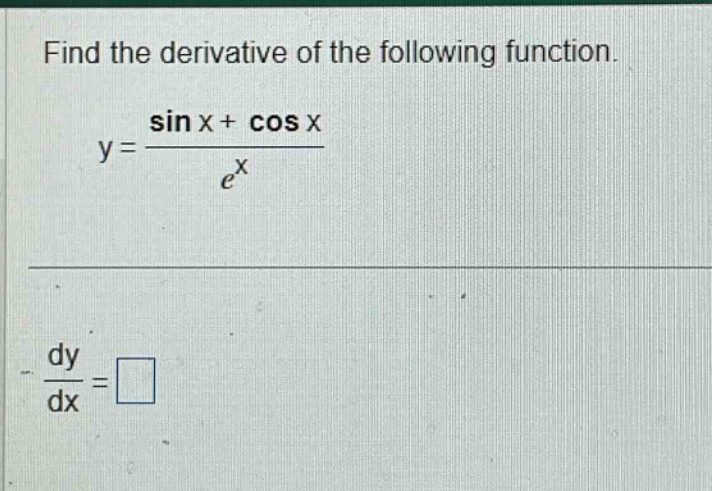
find the derivative of the following function.\ny = \\frac{\\sin x+\\cos x}{e^{x}}\n\\frac{dy}{dx}=\\square
Answer
Answer:
$\frac{-\sin x - \cos x}{e^{x}}$
Explanation:
Step1: Apply quotient - rule
The quotient - rule states that if $y=\frac{u}{v}$, then $y^\prime=\frac{u^\prime v - uv^\prime}{v^{2}}$. Here, $u = \sin x+\cos x$, $v = e^{x}$.
Step2: Find $u^\prime$
Differentiate $u=\sin x+\cos x$ with respect to $x$. Using the sum - rule of differentiation and the derivatives of $\sin x$ and $\cos x$, we have $u^\prime=\cos x-\sin x$.
Step3: Find $v^\prime$
Differentiate $v = e^{x}$ with respect to $x$. The derivative of $e^{x}$ is $e^{x}$, so $v^\prime=e^{x}$.
Step4: Substitute into quotient - rule
$y^\prime=\frac{(\cos x - \sin x)e^{x}-(\sin x+\cos x)e^{x}}{(e^{x})^{2}}$.
Step5: Simplify the expression
First, factor out $e^{x}$ in the numerator: $y^\prime=\frac{e^{x}(\cos x - \sin x-\sin x - \cos x)}{e^{2x}}$. Then, cancel out $e^{x}$ in the numerator and denominator: $y^\prime=\frac{- 2\sin x}{e^{x}}=\frac{-\sin x - \cos x}{e^{x}}$.