find the derivative.\n\frac{d}{dx}6x(x^{8}+1)^{5}\n\n\frac{d}{dx}6x(x^{8}+1)^{5}=square
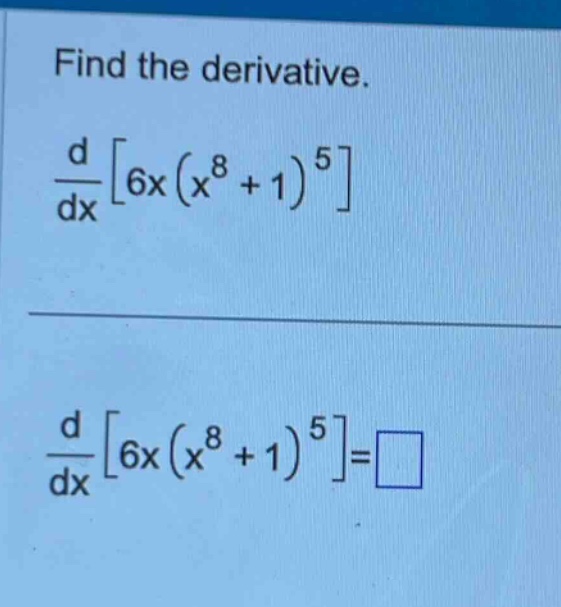
find the derivative.\n\frac{d}{dx}6x(x^{8}+1)^{5}\n\n\frac{d}{dx}6x(x^{8}+1)^{5}=square
Answer
Explanation:
Step1: Apply product - rule
The product - rule states that if $y = uv$, where $u$ and $v$ are functions of $x$, then $y^\prime=u^\prime v + uv^\prime$. Here, $u = 6x$ and $v=(x^{8}+1)^{5}$. First, find $u^\prime$ and $v^\prime$. The derivative of $u = 6x$ with respect to $x$ is $u^\prime=\frac{d}{dx}(6x)=6$.
Step2: Apply chain - rule to find $v^\prime$
Let $t=x^{8}+1$, then $v = t^{5}$. By the chain - rule $\frac{dv}{dx}=\frac{dv}{dt}\cdot\frac{dt}{dx}$. The derivative of $v$ with respect to $t$ is $\frac{dv}{dt}=5t^{4}$, and the derivative of $t$ with respect to $x$ is $\frac{dt}{dx}=8x^{7}$. So, $v^\prime = 5(x^{8}+1)^{4}\cdot8x^{7}=40x^{7}(x^{8}+1)^{4}$.
Step3: Calculate the derivative using product - rule
$y^\prime=u^\prime v+uv^\prime$. Substitute $u = 6x$, $u^\prime = 6$, $v=(x^{8}+1)^{5}$, and $v^\prime = 40x^{7}(x^{8}+1)^{4}$ into the product - rule formula: [ \begin{align*} y^\prime&=6(x^{8}+1)^{5}+6x\cdot40x^{7}(x^{8}+1)^{4}\ &=6(x^{8}+1)^{5}+240x^{8}(x^{8}+1)^{4}\ &=6(x^{8}+1)^{4}[(x^{8}+1)+40x^{8}]\ &=6(x^{8}+1)^{4}(41x^{8}+1) \end{align*} ]
Answer:
$6(x^{8}+1)^{4}(41x^{8}+1)$