find the derivative of the function.\ny = 2e^{-x}+e^{3x}\n\\frac{dy}{dx}=\\square
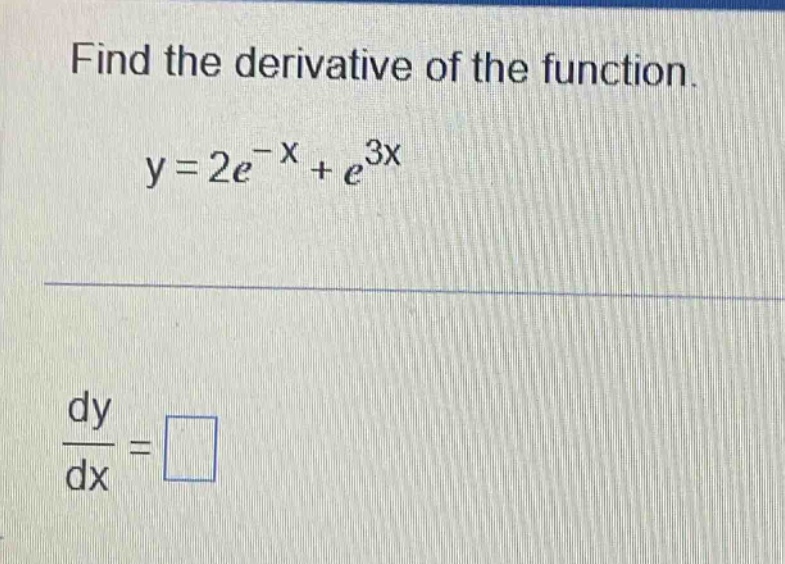
find the derivative of the function.\ny = 2e^{-x}+e^{3x}\n\\frac{dy}{dx}=\\square
Answer
Explanation:
Step1: Apply sum - rule of derivatives
The sum - rule states that if (y = u + v), then (\frac{dy}{dx}=\frac{du}{dx}+\frac{dv}{dx}). Let (u = 2e^{-x}) and (v=e^{3x}). So (\frac{dy}{dx}=\frac{d}{dx}(2e^{-x})+\frac{d}{dx}(e^{3x})).
Step2: Differentiate (u = 2e^{-x})
Using the constant - multiple rule (\frac{d}{dx}(cf(x))=c\frac{d}{dx}(f(x))) and the chain - rule (\frac{d}{dx}(e^{ax}) = ae^{ax}), for (u = 2e^{-x}), we have (\frac{d}{dx}(2e^{-x})=2\frac{d}{dx}(e^{-x})). Since (\frac{d}{dx}(e^{-x})=-e^{-x}), then (\frac{d}{dx}(2e^{-x})=- 2e^{-x}).
Step3: Differentiate (v = e^{3x})
Using the chain - rule (\frac{d}{dx}(e^{ax})=ae^{ax}) with (a = 3), we get (\frac{d}{dx}(e^{3x})=3e^{3x}).
Step4: Combine the results
(\frac{dy}{dx}=\frac{d}{dx}(2e^{-x})+\frac{d}{dx}(e^{3x})=-2e^{-x}+3e^{3x}).
Answer:
(-2e^{-x}+3e^{3x})