find the derivative of the function. g(v)=3v^3 - 48 find the values of v such that g(v)=0. (enter your…
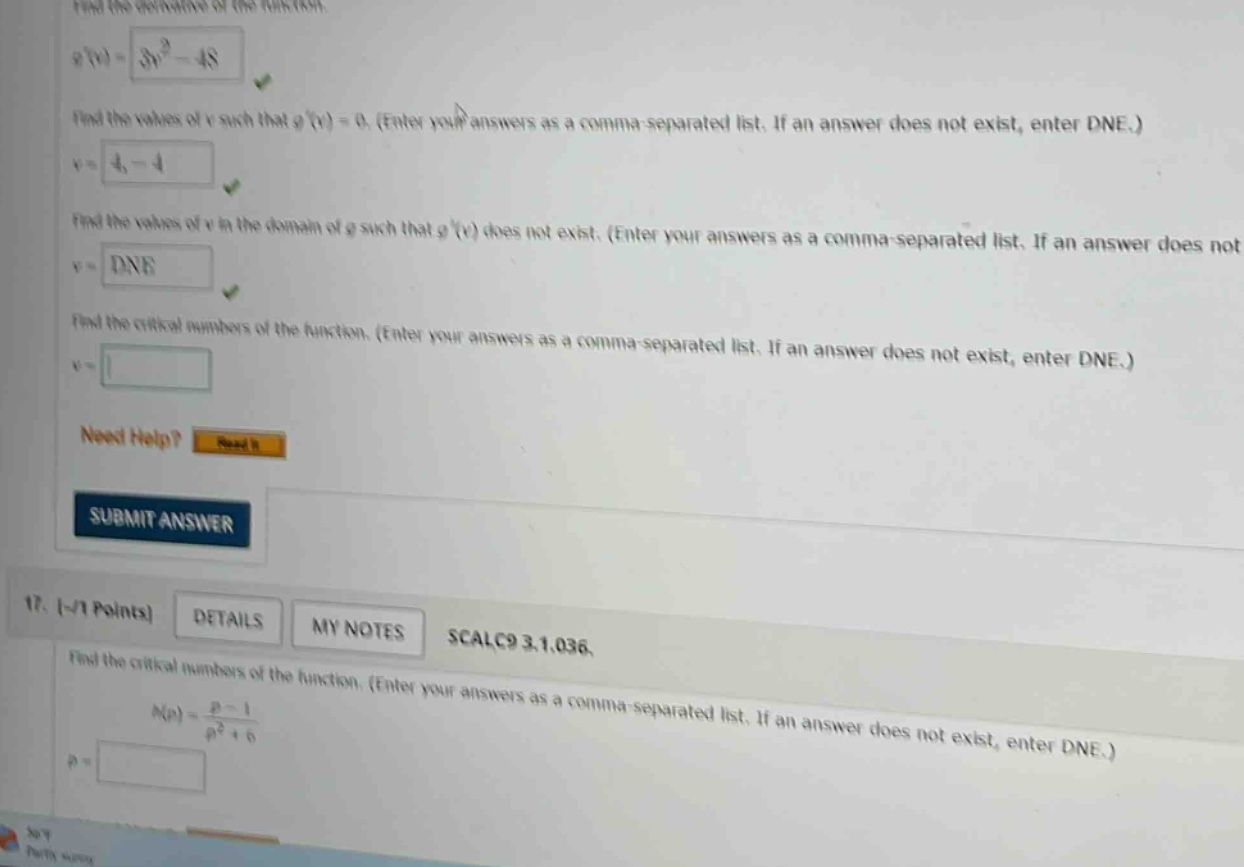
find the derivative of the function. g(v)=3v^3 - 48 find the values of v such that g(v)=0. (enter your answers as a comma - separated list. if an answer does not exist, enter dne.) v = 4, - 4 find the values of v in the domain of g such that g(v) does not exist. (enter your answers as a comma - separated list. if an answer does not exist, enter dne.) v = dne find the critical numbers of the function. (enter your answers as a comma - separated list. if an answer does not exist, enter dne.) v = 17. -/1 points details my notes scalc9 3.1.036. find the critical numbers of the function. (enter your answers as a comma - separated list. if an answer does not exist, enter dne.) h(p)=(p - 1)/(p^2+6) p =
Answer
- For the function (g(v)=3v^{2}-48):
- Recall that the critical - numbers of a function (y = g(v)) are the values of (v) in the domain of (g) where (g^{\prime}(v)=0) or (g^{\prime}(v)) does not exist.
- First, find the derivative of (g(v)) using the power rule. The power rule states that if (y = ax^{n}), then (y^{\prime}=nax^{n - 1}).
- For (g(v)=3v^{2}-48), (g^{\prime}(v)=\frac{d}{dv}(3v^{2}-48)).
- Using the sum - difference rule of differentiation (\frac{d}{dv}(u\pm v)=\frac{d}{dv}(u)\pm\frac{d}{dv}(v)), we have (g^{\prime}(v)=\frac{d}{dv}(3v^{2})-\frac{d}{dv}(48)).
- Since (\frac{d}{dv}(3v^{2}) = 3\times2v=6v) and (\frac{d}{dv}(48)=0) (the derivative of a constant is 0), (g^{\prime}(v)=6v).
- Set (g^{\prime}(v) = 0):
- (6v = 0).
- Solving for (v), we divide both sides by 6: (v = 0).
- The derivative (g^{\prime}(v)=6v) is a linear function and exists for all real - valued (v). So the values of (v) in the domain of (g) where (g^{\prime}(v)) does not exist is DNE.
- The critical numbers of (g(v)) are the values of (v) such that (g^{\prime}(v)=0) or (g^{\prime}(v)) does not exist. So the critical number of (g(v)) is (v = 0).
- For the function (h(p)=\frac{p - 1}{p^{2}+6}):
- Use the quotient rule to find the derivative. The quotient rule states that if (y=\frac{u}{v}), then (y^{\prime}=\frac{u^{\prime}v - uv^{\prime}}{v^{2}}), where (u = p - 1), (u^{\prime}=1), (v=p^{2}+6), and (v^{\prime}=2p).
- (h^{\prime}(p)=\frac{1\times(p^{2}+6)-(p - 1)\times(2p)}{(p^{2}+6)^{2}}).
- Expand the numerator:
- (h^{\prime}(p)=\frac{p^{2}+6-(2p^{2}-2p)}{(p^{2}+6)^{2}}=\frac{p^{2}+6 - 2p^{2}+2p}{(p^{2}+6)^{2}}=\frac{-p^{2}+2p + 6}{(p^{2}+6)^{2}}).
- Set (h^{\prime}(p)=0). Since ((p^{2}+6)^{2}\gt0) for all real (p) (because (p^{2}\geq0) for all real (p), so (p^{2}+6\gt0)), we only need to set the numerator equal to 0.
- (-p^{2}+2p + 6 = 0). Multiply through by - 1 to get (p^{2}-2p - 6=0).
- Use the quadratic formula (p=\frac{-b\pm\sqrt{b^{2}-4ac}}{2a}) for a quadratic equation (ax^{2}+bx + c = 0). Here, (a = 1), (b=-2), and (c=-6).
- (p=\frac{2\pm\sqrt{(-2)^{2}-4\times1\times(-6)}}{2\times1}=\frac{2\pm\sqrt{4 + 24}}{2}=\frac{2\pm\sqrt{28}}{2}=\frac{2\pm2\sqrt{7}}{2}=1\pm\sqrt{7}).
- The derivative (h^{\prime}(p)) is a rational function and the denominator ((p^{2}+6)^{2}) is never 0 for real (p). So the values of (p) where (h^{\prime}(p)) does not exist is DNE.
- The critical numbers of (h(p)) are (p = 1+\sqrt{7},1 - \sqrt{7}).
- Use the quotient rule to find the derivative. The quotient rule states that if (y=\frac{u}{v}), then (y^{\prime}=\frac{u^{\prime}v - uv^{\prime}}{v^{2}}), where (u = p - 1), (u^{\prime}=1), (v=p^{2}+6), and (v^{\prime}=2p).
Explanation:
Step1: Find derivative of (g(v))
Using power rule, (g^{\prime}(v)=6v)
Step2: Find (v) for (g^{\prime}(v)=0)
Set (6v = 0), so (v = 0)
Step3: Check where (g^{\prime}(v)) does not exist
(g^{\prime}(v)) exists for all (v), so DNE
Step4: Find critical numbers of (g(v))
Critical number is (v = 0)
Step5: Find derivative of (h(p))
Using quotient rule, (h^{\prime}(p)=\frac{-p^{2}+2p + 6}{(p^{2}+6)^{2}})
Step6: Find (p) for (h^{\prime}(p)=0)
Set (-p^{2}+2p + 6 = 0), use quadratic formula (p = 1\pm\sqrt{7})
Step7: Check where (h^{\prime}(p)) does not exist
(h^{\prime}(p)) exists for all (p), so DNE
Step8: Find critical numbers of (h(p))
Critical numbers are (p = 1+\sqrt{7},1 - \sqrt{7})
Answer:
For (g(v)=3v^{2}-48), critical number: (0); For (h(p)=\frac{p - 1}{p^{2}+6}), critical numbers: (1+\sqrt{7},1 - \sqrt{7})