find the derivative of the function.\nf(x)=(4x + 6)^2\n\na. f(x)=16x + 24\nb. f(x)=16x + 36\nc. f(x)=32x +…
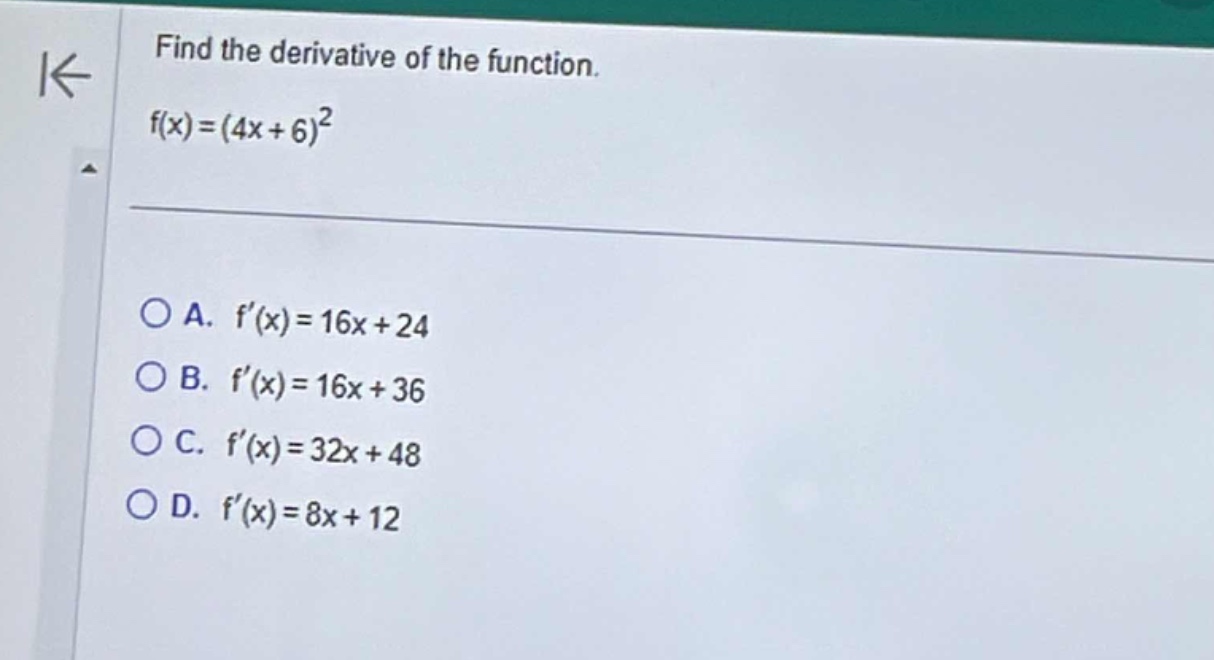
find the derivative of the function.\nf(x)=(4x + 6)^2\n\na. f(x)=16x + 24\nb. f(x)=16x + 36\nc. f(x)=32x + 48\nd. f(x)=8x + 12
Answer
Explanation:
Step1: Apply chain - rule
Let $u = 4x+6$, then $f(x)=u^{2}$. The chain - rule states that $\frac{df}{dx}=\frac{df}{du}\cdot\frac{du}{dx}$. First, find $\frac{df}{du}$ and $\frac{du}{dx}$. $\frac{df}{du}=\frac{d(u^{2})}{du}=2u$ and $\frac{du}{dx}=\frac{d(4x + 6)}{dx}=4$.
Step2: Substitute $u$ back and calculate
$\frac{df}{dx}=2u\cdot4$. Substitute $u = 4x+6$ back into the equation: $\frac{df}{dx}=2(4x + 6)\cdot4=8(4x + 6)=32x+48$.
Answer:
C. $f^{\prime}(x)=32x + 48$