a. find the derivative function f’ for the function f. b. find an equation of the line tangent to the graph…
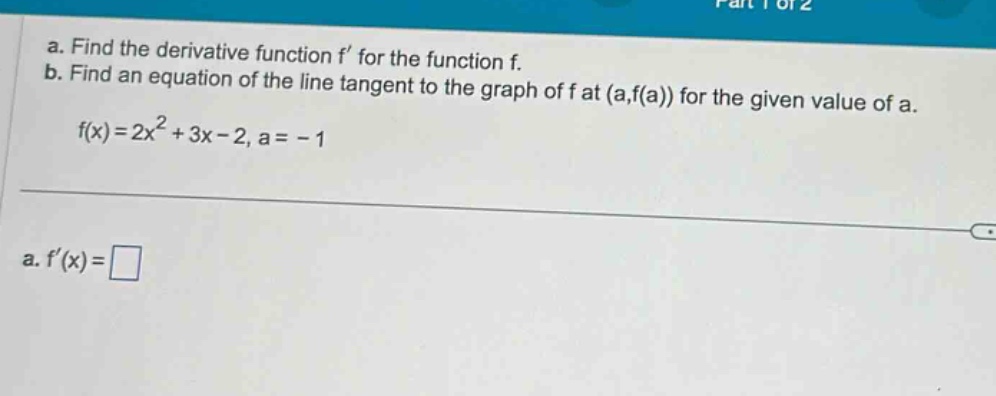
a. find the derivative function f’ for the function f. b. find an equation of the line tangent to the graph of f at (a,f(a)) for the given value of a. f(x)=2x² + 3x - 2, a = -1 a. f’(x)=□
Answer
Answer:
$4x + 3$
Explanation:
Step1: Recall power - rule
The power - rule states that if $y = x^n$, then $y^\prime=nx^{n - 1}$. For a function $y = ax^n+bx^m+\cdots$, the derivative $y^\prime=anx^{n - 1}+bmx^{m - 1}+\cdots$.
Step2: Differentiate each term
Given $f(x)=2x^{2}+3x - 2$. The derivative of $2x^{2}$ using the power - rule: If $y = 2x^{2}$, then $y^\prime=2\times2x^{2 - 1}=4x$. The derivative of $3x$: If $y = 3x$, then $y^\prime=3\times1x^{1 - 1}=3$. The derivative of the constant $-2$ is $0$ (since the derivative of a constant $C$ is $0$).
Step3: Combine the derivatives
$f^\prime(x)$ is the sum of the derivatives of each term. So $f^\prime(x)=4x + 3$.