(a) find the derivative ( f^{prime}(x) ) of the function ( f(x)=\frac{x^{3}}{5} ).\n(b) graph ( f(x) ) and (…
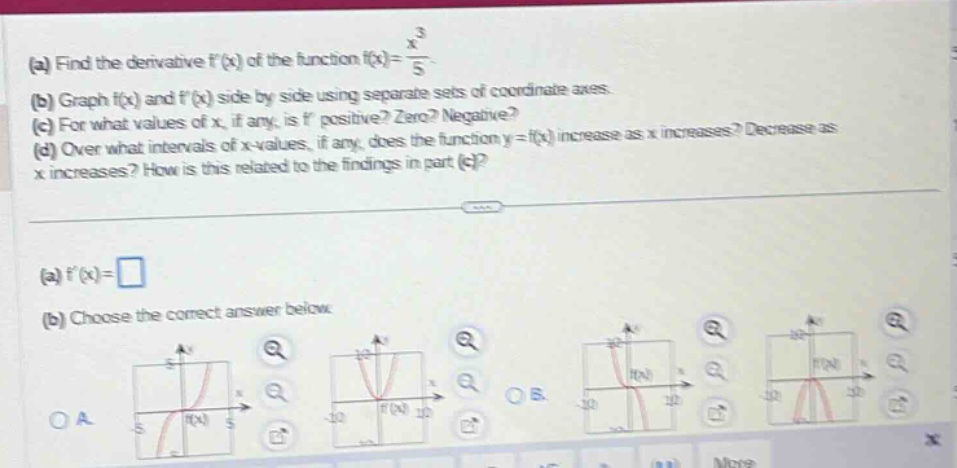
(a) find the derivative ( f^{prime}(x) ) of the function ( f(x)=\frac{x^{3}}{5} ).\n(b) graph ( f(x) ) and ( f^{prime}(x) ) side - by - side using separate sets of coordinate axes.\n(c) for what values of ( x ), if any, is ( f^{prime} ) positive? zero? negative?\n(d) over what intervals of ( x ) - values, if any, does the function ( y = f(x) ) increase as ( x ) increases? decrease as ( x ) increases? how is this related to the findings in part (c)?\n\n(a) ( f^{prime}(x)=square )\n(b) choose the correct answer below.
Answer
Explanation:
Step1: Apply power - rule for derivatives
The power - rule states that if $y = ax^n$, then $y^\prime=anx^{n - 1}$. For the function $f(x)=\frac{x^{3}}{5}=\frac{1}{5}x^{3}$, where $a=\frac{1}{5}$ and $n = 3$. $f^\prime(x)=\frac{1}{5}\times3x^{3 - 1}=\frac{3}{5}x^{2}$
Step2: Analyze the sign of the derivative
Set $f^\prime(x)=\frac{3}{5}x^{2}=0$. Solving for $x$, we get $x = 0$. Since $\frac{3}{5}>0$ and $x^{2}\geq0$ for all real $x$, $f^\prime(x)>0$ for $x\neq0$ and $f^\prime(x) = 0$ when $x = 0$.
Step3: Relate the sign of the derivative to the function's behavior
A function $y = f(x)$ is increasing when $f^\prime(x)>0$ and decreasing when $f^\prime(x)<0$. Since $f^\prime(x)=\frac{3}{5}x^{2}>0$ for $x\neq0$ and $f^\prime(x) = 0$ at $x = 0$, the function $y = f(x)$ is increasing for $x\in(-\infty,0)\cup(0,\infty)$ and has a horizontal tangent at $x = 0$.
Answer:
(a) $f^\prime(x)=\frac{3}{5}x^{2}$ (b) The function $f(x)=\frac{x^{3}}{5}$ is a cubic function passing through the origin with a relatively flat slope near the origin. Its derivative $f^\prime(x)=\frac{3}{5}x^{2}$ is a parabola opening upwards with vertex at the origin. (Without the actual options, we can't choose from A - D, but the graph of $y = f(x)$ has an S - shape and $y = f^\prime(x)$ is a U - shape). (c) $f^\prime(x)$ is positive for $x\neq0$, zero for $x = 0$, and never negative. (d) The function $y = f(x)$ increases for $x\in(-\infty,0)\cup(0,\infty)$. This is related to part (c) because the function $y = f(x)$ increases when $f^\prime(x)>0$ and has a horizontal tangent (neither increasing nor decreasing) when $f^\prime(x)=0$.