find the derivative. f(x) if f(x)=(e^x2 - 3)^5 f(x)=
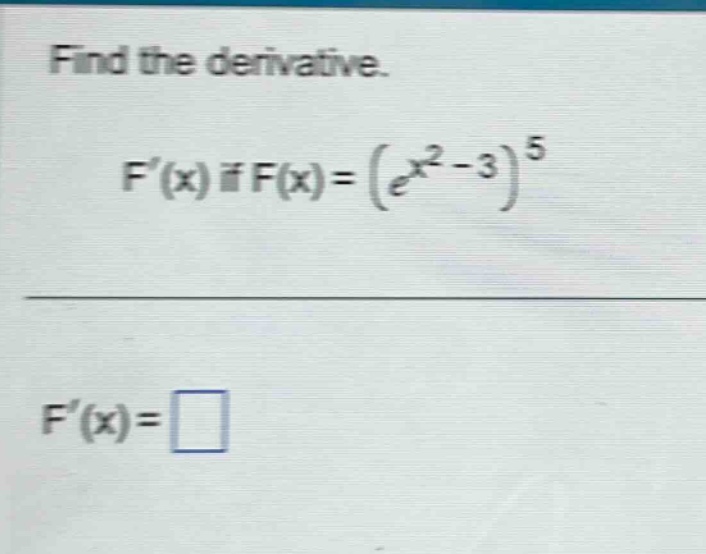
find the derivative. f(x) if f(x)=(e^x2 - 3)^5 f(x)=
Answer
Explanation:
Step1: Apply chain - rule
Let $u = e^{x^{2}-3}$, then $F(x)=u^{5}$. The chain - rule states that $F^\prime(x)=\frac{dF}{du}\cdot\frac{du}{dx}$. First, find $\frac{dF}{du}$. $\frac{dF}{du}=\frac{d}{du}(u^{5}) = 5u^{4}$
Step2: Find $\frac{du}{dx}$
Let $v=x^{2}-3$, then $u = e^{v}$. By the chain - rule again, $\frac{du}{dx}=\frac{du}{dv}\cdot\frac{dv}{dx}$. We know that $\frac{du}{dv}=\frac{d}{dv}(e^{v})=e^{v}$ and $\frac{dv}{dx}=\frac{d}{dx}(x^{2}-3)=2x$. So $\frac{du}{dx}=e^{v}\cdot2x = 2x e^{x^{2}-3}$
Step3: Calculate $F^\prime(x)$
Substitute $u = e^{x^{2}-3}$ and $\frac{du}{dx}=2x e^{x^{2}-3}$ into the chain - rule formula $F^\prime(x)=\frac{dF}{du}\cdot\frac{du}{dx}$. $F^\prime(x)=5u^{4}\cdot2x e^{x^{2}-3}=5(e^{x^{2}-3})^{4}\cdot2x e^{x^{2}-3}$ Using the property of exponents $a^{m}\cdot a^{n}=a^{m + n}$, we have $F^\prime(x)=10x e^{4(x^{2}-3)+(x^{2}-3)}=10x e^{5(x^{2}-3)}$
Answer:
$10x e^{5(x^{2}-3)}$