find dr/dθ for r = sin θ tan θ. choose the correct answer. a. dr/dθ = sec θ·(sin²θ + 1) b. dr/dθ = sin…
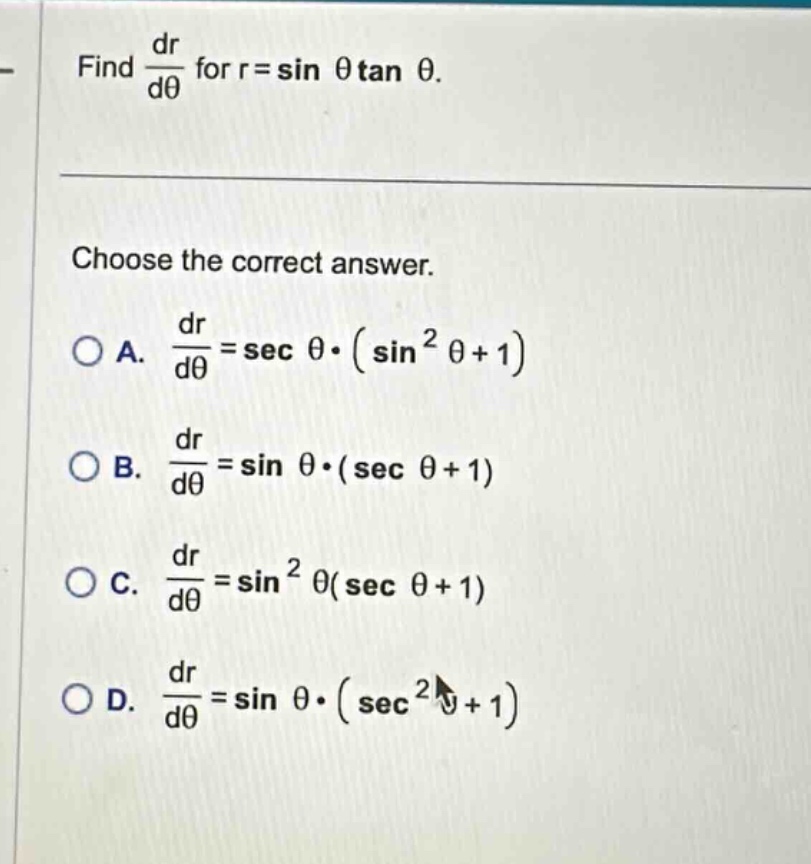
find dr/dθ for r = sin θ tan θ. choose the correct answer. a. dr/dθ = sec θ·(sin²θ + 1) b. dr/dθ = sin θ·(sec θ + 1) c. dr/dθ = sin²θ(sec θ + 1) d. dr/dθ = sin θ·(sec²θ + 1)
Answer
Answer:
A. $\frac{dr}{d\theta}=\sec\theta\cdot(\sin^{2}\theta + 1)$
Explanation:
Step1: Apply product - rule
If $r = u\cdot v$ where $u=\sin\theta$ and $v = \tan\theta$, then $\frac{dr}{d\theta}=u'\cdot v+u\cdot v'$.
Step2: Find $u'$
The derivative of $u = \sin\theta$ with respect to $\theta$ is $u'=\cos\theta$.
Step3: Find $v'$
The derivative of $v=\tan\theta$ with respect to $\theta$ is $v'=\sec^{2}\theta$.
Step4: Substitute $u$, $v$, $u'$, $v'$
$\frac{dr}{d\theta}=\cos\theta\cdot\tan\theta+\sin\theta\cdot\sec^{2}\theta$.
Step5: Simplify
Since $\tan\theta=\frac{\sin\theta}{\cos\theta}$, then $\cos\theta\cdot\tan\theta=\sin\theta$. So $\frac{dr}{d\theta}=\sin\theta+\sin\theta\cdot\sec^{2}\theta=\sin\theta(1 + \sec^{2}\theta)=\sec\theta\cdot(\sin^{2}\theta + 1)$.