find an equation for the cosine graph, f(x):\nwrite your answer in the form f(x) = acos(bx + c) + d, where…
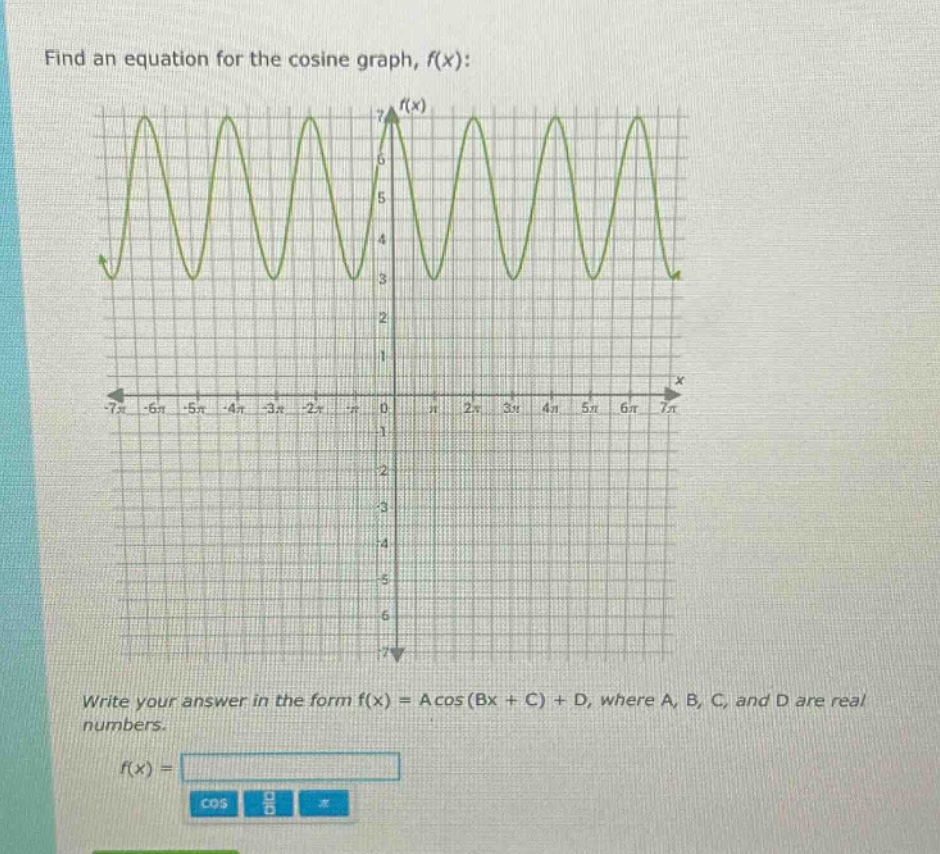
find an equation for the cosine graph, f(x):\nwrite your answer in the form f(x) = acos(bx + c) + d, where a, b, c, and d are real numbers.\nf(x) =
Answer
Explanation:
Step1: Determine the amplitude A
The amplitude is half the vertical distance between the maximum and minimum values. The maximum value is 7 and the minimum is 3. So, $A=\frac{7 - 3}{2}=\frac{4}{2}=2$.
Step2: Determine the vertical - shift D
The vertical - shift D is the mid - value between the maximum and minimum values. So, $D=\frac{7 + 3}{2}=5$.
Step3: Determine the period and B
The period of the cosine function is the horizontal distance between two consecutive maxima or minima. Here, the period $T = 2\pi$. The formula for the period of $y = A\cos(Bx + C)+D$ is $T=\frac{2\pi}{|B|}$. Since $T = 2\pi$, then $B = 1$.
Step4: Determine the phase - shift C
The graph of $y = A\cos(Bx + C)+D$ is a cosine graph with no phase - shift (the cosine function starts at its maximum value as in the standard $y=\cos(x)$ graph), so $C = 0$.
Answer:
$f(x)=2\cos(x)+5$