find the equation of the graph given below.
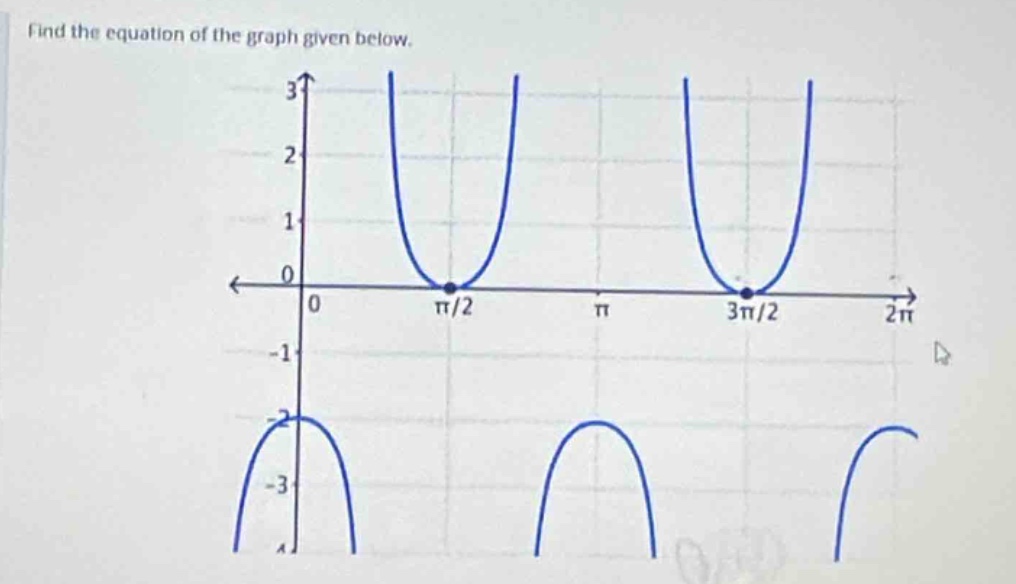
find the equation of the graph given below.
Answer
Explanation:
Step1: Identify the basic function type
The graph has vertical asymptotes and a repeating pattern, resembling the secant - function $y = A\sec(Bx - C)+D$. The period of the secant function $y=\sec x$ is $2\pi$. Here, the period of the given function is $\pi$.
Step2: Find the value of B
The period formula for $y = A\sec(Bx - C)+D$ is $T=\frac{2\pi}{|B|}$. Since $T = \pi$, we have $\pi=\frac{2\pi}{|B|}$. Solving for $B$ gives $|B| = 2$.
Step3: Determine the amplitude and vertical shift
The graph has a minimum value of $0$ and a maximum value of $3$ in each period. For the secant function $y = A\sec(Bx - C)+D$, the range is $(-\infty,D - |A|]\cup[D + |A|,\infty)$. Since the mid - line of the graph is $y=\frac{0 + 3}{2}=\frac{3}{2}$, then $D=\frac{3}{2}$. Also, $|A|=\frac{3}{2}$.
Step4: Check for phase - shift
The graph is symmetric about the vertical lines $x=\frac{\pi}{2}+k\pi,k\in\mathbb{Z}$, so $C = 0$. The equation of the graph is $y=\frac{3}{2}\sec(2x)+\frac{3}{2}$.
Answer:
$y=\frac{3}{2}\sec(2x)+\frac{3}{2}$