find an equation for the graph shown to the right.\ntype the equation in the form y = a sin(ωx) or y = a…
find an equation for the graph shown to the right.\ntype the equation in the form y = a sin(ωx) or y = a cos(ωx).\ny = \n(type an exact answer, using π as needed. use integers or fractions for any numbers in the expression.)
Answer
Explanation:
Step1: Determine the amplitude A
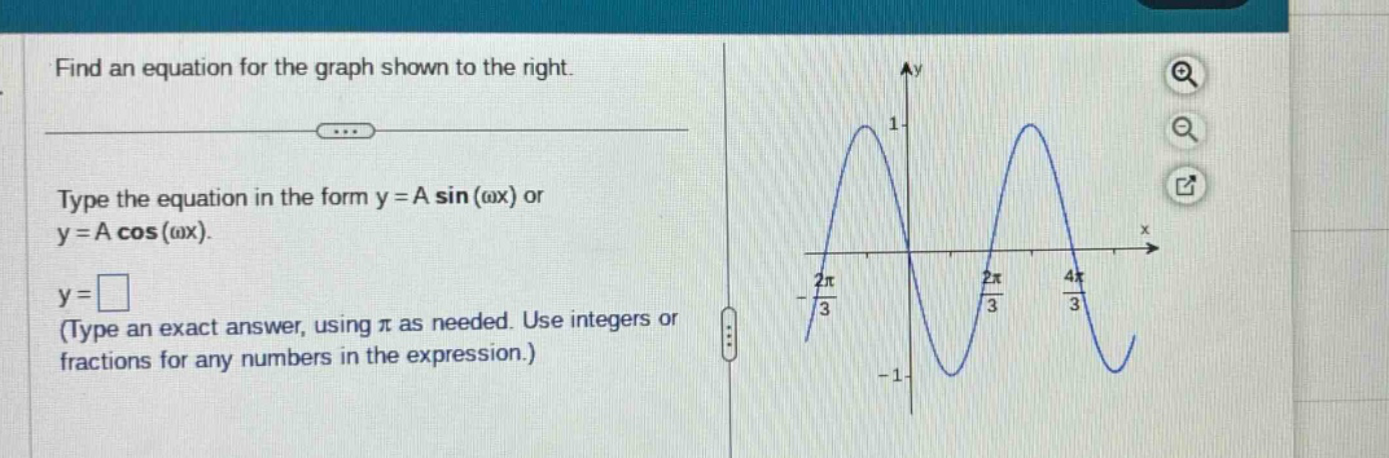
The amplitude is the maximum distance from the mid - line to the peak or trough. The mid - line is $y = 0$, and the maximum value is $y = 1$ and the minimum is $y=-1$. So, $A = 1$.
Step2: Determine the period T
The period is the distance between two consecutive peaks or troughs. From the graph, the distance between two consecutive peaks (e.g., from $x = 0$ to $x=\frac{4\pi}{3}$) is $T=\frac{4\pi}{3}$.
Step3: Calculate the angular frequency ω
The formula for the period of a sine or cosine function is $T=\frac{2\pi}{\omega}$. Substituting $T = \frac{4\pi}{3}$ into the formula: [ \begin{align*} \frac{4\pi}{3}&=\frac{2\pi}{\omega}\ 4\pi\omega&=6\pi\ \omega&=\frac{3}{2} \end{align*} ]
Step4: Determine the function type
Since the graph passes through the origin $(0,0)$, the function is of the form $y = A\sin(\omega x)$.
Answer:
$y=\sin\left(\frac{3}{2}x\right)$