find the equation of all horizontal asymptotes (if any) of the rational function. f(x) = (8x^3 - x^2 +…
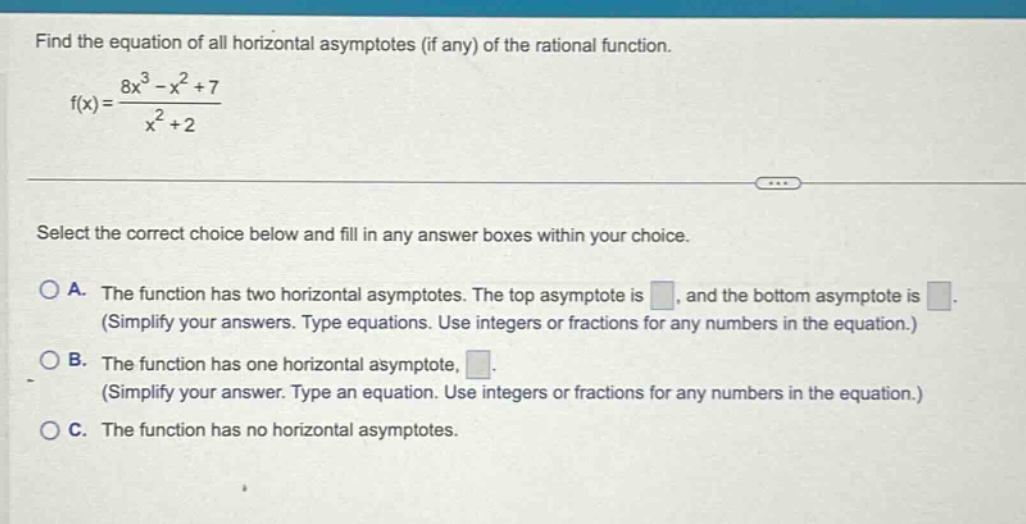
find the equation of all horizontal asymptotes (if any) of the rational function. f(x) = (8x^3 - x^2 + 7)/(x^2 + 2) select the correct choice below and fill in any answer boxes within your choice. a. the function has two horizontal asymptotes. the top asymptote is , and the bottom asymptote is . (simplify your answers. type equations. use integers or fractions for any numbers in the equation.) b. the function has one horizontal asymptote, . (simplify your answer. type an equation. use integers or fractions for any numbers in the equation.) c. the function has no horizontal asymptotes.
Answer
Explanation:
Step1: Compare degrees of polynomials
The degree of the numerator $8x^{3}-x^{2}+7$ is $n = 3$ and the degree of the denominator $x^{2}+2$ is $m=2$.
Step2: Apply horizontal - asymptote rule
When $n>m$ (where $n$ is the degree of the numerator and $m$ is the degree of the denominator of a rational function), there are no horizontal asymptotes.
Answer:
C. The function has no horizontal asymptotes.